
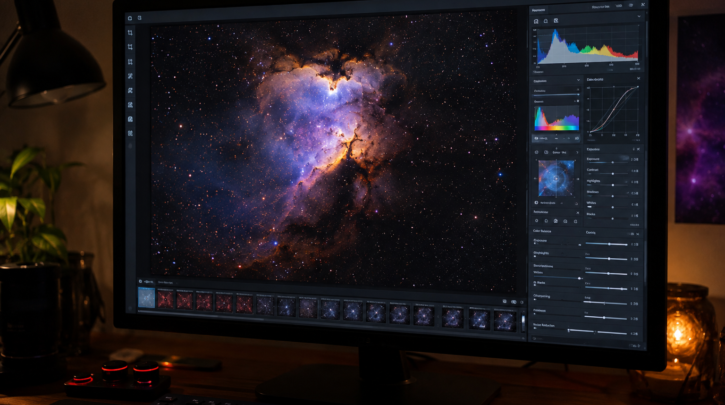

Most detailed astrophotos aren’t a single perfect exposure — they’re dozens or hundreds of shorter exposures stacked together to boost signal and reduce noise, then processed to bring out detail that isn’t visible in any individual frame. Understanding this basic workflow demystifies a lot of what looks like impossible skill in finished astrophotography images.
Why Stacking Works
Random image noise varies between exposures, while the actual signal from a star or nebula stays consistent. Averaging many aligned exposures together cancels out much of that random noise while the real signal reinforces itself, which is why a stack of fifty 30-second exposures reveals dramatically more detail than a single 30-second shot, even though the total exposure time is the same.
Shooting for a Stack
Capturing a stackable set means taking many exposures of the same framing without moving the camera, ideally supplemented with calibration frames: dark frames (exposures with the lens capped, same settings, to capture sensor noise patterns) and flat frames (evenly lit blank exposures that reveal dust spots and vignetting). These calibration frames get subtracted or divided out during stacking to further clean up the final result.
Free and Affordable Stacking Software
DeepSkyStacker and Sequator are widely used free options for stacking star and nightscape images on Windows, handling the alignment and combination automatically once you feed in your exposures and any calibration frames. Siril is a more advanced free option that also handles deep-sky processing steps beyond basic stacking, and it runs on Windows, Mac, and Linux.
Basic Processing After Stacking
Once stacked, an image typically needs levels or curves adjustments to bring out the faint signal that’s present but not yet visible, gradient removal to correct the uneven sky glow that light pollution creates across a frame, and noise reduction to smooth out whatever grain remains after stacking. Restraint matters here — pushing adjustments too far produces unnatural-looking halos around stars or oversaturated colors that look more like a mistake than a highlight.
Software for Deeper Processing
Free tools like GIMP handle basic adjustments well, while paid software like Adobe Lightroom offers a smoother RAW-editing workflow for nightscape and Milky Way images specifically. For serious deep-sky processing — extracting maximum detail from stacked nebula or galaxy data — dedicated software like PixInsight is the standard among advanced astrophotographers, though it comes with a real cost and a genuinely steep learning curve.
Smart Telescopes Handle Most of This Automatically
One of the biggest practical advantages of a smart telescope is that the stacking and much of the basic processing happens automatically inside the device and its app, in real time, without ever touching separate stacking or editing software. This removes the steepest part of the traditional learning curve described here; see our smart telescope guide for how that automated pipeline compares to manual processing.
Editing Is a Skill, Not a One-Time Setting
Like the rest of astrophotography, editing improves with repetition far more than through any single tutorial. Reprocessing an old stacked image after a few months of practice often reveals just how much room for improvement existed in the original edit, which is a normal and useful part of getting better rather than a sign the original data was flawed.
Keeping a Non-Destructive Workflow
Working from RAW files and saving edits as a separate processed copy, rather than overwriting original data, keeps every stacked and calibrated exposure available for reprocessing later with better skills or newer software. This matters more in astrophotography than most other photography genres, since the raw stacked data often holds more recoverable detail than a first-pass edit manages to extract.
Realistic Time Expectations
A single finished deep-sky image can represent hours of exposure time in the field plus a similar amount of processing time at a computer, which surprises people expecting a quick edit. Budgeting real time for the processing side, not just the imaging session itself, avoids the common frustration of raw stacked data looking underwhelming compared to finished images seen online before any editing has been applied.
Treating processing as its own skill worth practicing, rather than an afterthought to the imaging session, is what separates consistently good results from a folder of underwhelming raw stacks.
Even modest, careful edits applied consistently across a growing body of images will outperform occasional heavy-handed processing on a single shot.