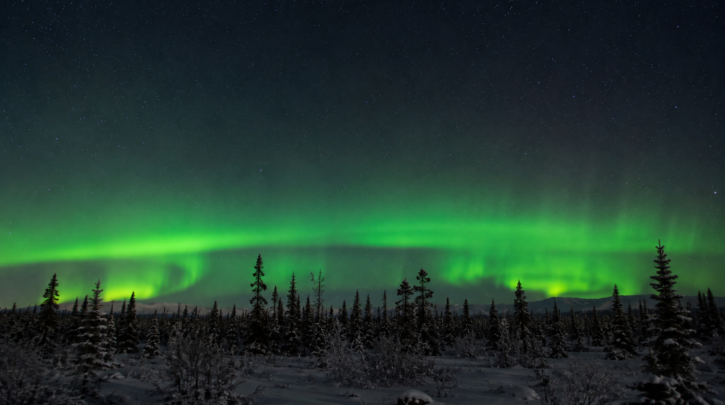

Alaska offers by far the most reliable aurora viewing in the United States, sitting directly under the auroral oval for much of the year, but a strong enough geomagnetic storm can bring the northern lights within reach of the northern tier of the Lower 48 states too.
Alaska: The Most Reliable US Option
Fairbanks, Alaska sits almost directly beneath the auroral oval, which makes it one of the most famous and consistent aurora-viewing locations in the world — clear, cold nights there have a genuinely good chance of showing some aurora activity on a fairly routine basis, not just during major storms. The viewing season generally runs from around late August through April, since the near-continuous daylight of Alaskan summer makes the aurora impossible to see even when it’s active.
Northern Tier of the Lower 48
During moderate-to-strong geomagnetic storms, states along the northern border of the continental US have a realistic shot at seeing the aurora, typically low on the northern horizon. Northern Minnesota, Wisconsin, and Michigan’s Upper Peninsula; Maine; North Dakota; Montana; and northern Washington State are among the most commonly cited locations, combining northern latitude with, in several cases, genuinely dark rural skies.
Combining Dark Skies With Northern Latitude
A handful of specific parks pair both advantages particularly well: Voyageurs National Park in Minnesota, Isle Royale National Park in Michigan, Acadia National Park in Maine, and Glacier National Park in Montana all combine northern position with certified or near-certified dark skies, making them popular targets for aurora chasers in the Lower 48; see our dark-sky destinations guide for more on what makes these locations dark in the first place.
How Far South the Aurora Can Reach
During an unusually powerful geomagnetic storm, the aurora has been documented reaching remarkably far south — the severe storm of May 2024, for example, produced visible aurora across much of the continental United States, including states far removed from the usual viewing zone. Events at that intensity are rare, but they’re a real reminder that the usual geographic guidance is a matter of odds and typical conditions rather than a hard limit.
Why Alaska Still Has the Edge
Even accounting for occasional extreme storms reaching the Lower 48, Alaska’s position directly under the auroral oval means aurora activity there doesn’t require a rare, historically strong storm — routine, moderate geomagnetic activity is often enough for a solid display on a clear night, which is why dedicated aurora tourism is concentrated there rather than anywhere in the Lower 48.
Checking Conditions Before You Travel
Wherever you’re headed, checking a real-time aurora forecast and Kp index prediction before committing to a trip is essential, since even the best location won’t show anything during a quiet stretch of solar activity; see our aurora forecast guide for the tools that give the most reliable short-term picture.
Local Light Pollution Still Matters
Even in a location with excellent odds of aurora activity, nearby city lights or a bright moon will wash out all but the strongest displays, the same way they wash out faint deep-sky objects; see our light pollution guide for why getting away from artificial light remains just as important for aurora chasing as for any other faint sky phenomenon.
Combining an Aurora Trip With Other Astronomy
Many of the same northern, dark-sky locations that favor aurora viewing are also excellent for general stargazing and deep-sky observing on nights without aurora activity, which makes a multi-night trip a reasonable hedge against any single night’s solar activity falling short; see our deep-sky observing guide for what else to plan for during the same trip.
Timing Within the Season
Beyond the broad August-through-April window, aurora activity isn’t evenly distributed — the weeks around the spring and fall equinoxes are statistically associated with somewhat higher geomagnetic activity due to the alignment between Earth’s magnetic field and the solar wind, which is worth keeping in mind when choosing when within the season to plan a trip, alongside the more immediate short-term forecast.
What to Expect Beyond the US
For travelers willing to go further, northern Canada, Iceland, Norway, and other high-latitude countries offer aurora odds that meet or exceed Alaska’s, often with more developed aurora-tourism infrastructure built specifically around guided viewing trips. These destinations sit outside the scope of a US-focused guide, but they’re worth knowing about for anyone for whom the aurora itself, rather than a specifically domestic trip, is the priority.