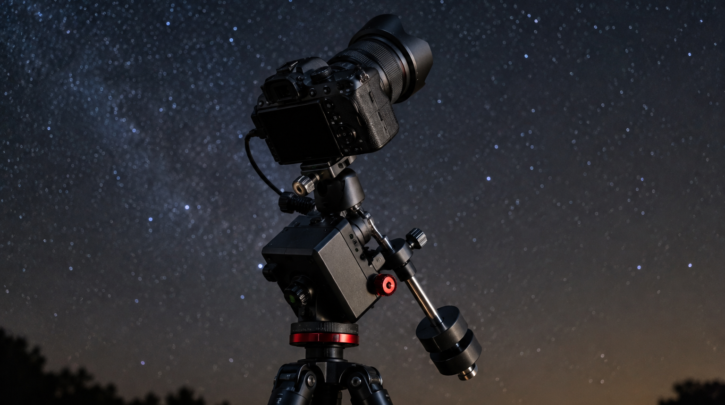

A star tracker is a small motorized mount that rotates a camera to match Earth’s rotation, allowing exposures dramatically longer than a static tripod shot without stars trailing into streaks. For wide-field and Milky Way photography, it’s often the single biggest upgrade available after a camera and lens.
Why Tracking Changes Everything
Without tracking, exposure length is capped by star trailing at anywhere from a few seconds to around 30 seconds depending on focal length, which limits how much light — and therefore detail and color — a single exposure can capture. A tracked exposure can run for minutes instead of seconds, gathering far more signal and revealing far more of the Milky Way’s color and structure than an untracked shot ever could, even before any stacking is involved.
How Polar Alignment Works
A star tracker needs its rotational axis aligned with Earth’s own axis to track accurately, which in practice means pointing it at Polaris using a built-in polar scope or an alignment app; see our North Star guide for locating Polaris in the first place. Alignment accuracy directly affects how long an exposure can run before any drift becomes visible, so it’s worth taking the extra few minutes to get it right rather than rushing.
Popular Entry-Level Trackers
The Sky-Watcher Star Adventurer and iOptron SkyGuider Pro are two of the most commonly recommended entry-level trackers, both compact, battery-powered, and priced roughly in the $300 to $500 range. They mount between a standard tripod and a ball head, adding rotation without adding much bulk or weight to a travel kit, which matters if you’re bringing gear to a remote dark-sky location.
Payload Capacity
Every tracker has a maximum payload weight, and exceeding it causes tracking accuracy to suffer even if the mount physically holds the camera. A basic camera body with a wide prime lens sits comfortably within most entry-level trackers’ limits, but adding a heavier telephoto lens or a small guide scope setup can push closer to the limit, worth checking against the specific tracker’s rated capacity before buying.
What a Tracker Doesn’t Do
A star tracker handles rotation only — it doesn’t point at or find a specific target automatically, doesn’t stack images, and doesn’t correct for polar alignment errors on its own. This is where a smart telescope differs fundamentally: it bundles tracking with automated target selection and live stacking into one system, at a considerably higher price; see our smart telescope guide for that comparison.
When a Tracker Is the Right Choice
For wide-field nightscapes and Milky Way photography specifically, a star tracker paired with a camera and wide lens remains one of the best value upgrades in astrophotography, since it directly addresses the single biggest limitation — exposure time — at a fraction of the cost of a full deep-sky imaging rig or a smart telescope. For deep-sky targets like galaxies and nebulae specifically, the gap between a tracker-only setup and a properly guided telescope rig or smart telescope widens considerably.
Setting Up in the Field
A typical field setup involves leveling the tripod, roughly aiming the tracker’s polar axis north, fine-tuning through a polar scope or app-assisted alignment, then mounting the camera and ball head on top. Doing this in dim red light rather than full darkness, and practicing the sequence at home in daylight first, turns what feels fiddly on a first attempt into a routine five-minute setup after a session or two.
Combining a Tracker With Stacking
Trackers and stacking aren’t an either-or choice — many photographers use a tracker to take several longer, tracked exposures and then stack those together afterward, combining the benefits of both techniques. This produces meaningfully better results than either approach alone, since tracking increases the signal in each individual frame while stacking further reduces the remaining noise across the set; see our editing basics guide for how that combined workflow comes together.
For the money, a tracker plus a stacking workflow is hard to beat as an upgrade path before committing to a full telescope-based imaging rig.
It’s also gear that keeps its value well, since a tracker bought today will still be useful years from now even if the rest of your kit changes.