
Galaxy hunting flips the priorities that matter for planetary viewing: aperture matters more than focal ratio, and a genuinely dark sky matters more than almost any equipment upgrade. It’s also the category where the gap between traditional and smart telescopes is largest — and most interesting to understand honestly.
Aperture Above All Else
Galaxies are faint, extended objects, and more aperture directly means more gathered light and, usually, more visible structure. This is why “aperture fever” — the urge to keep upgrading to a bigger telescope — is such a real and common phenomenon among dedicated deep-sky observers; for galaxies specifically, there’s rarely such a thing as too much aperture, only practical limits on cost, size, and portability.
Dobsonians: Still the Best Value
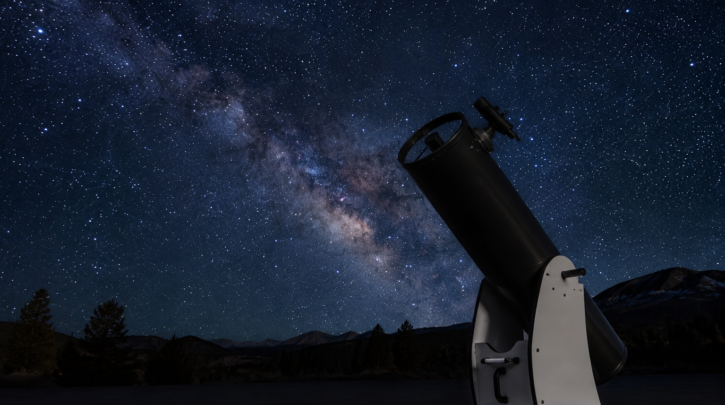
Large Dobsonian telescopes remain the best traditional aperture-per-dollar option for galaxy hunting, since their simple rocker-box mount adds very little cost compared to an equivalent equatorial setup. An 8-inch or larger Dobsonian, used under a dark sky, will show considerably more galaxy structure — spiral hints, brighter cores, companion galaxies — than the same aperture would reveal from a light-polluted backyard.
Focal Ratio Matters Less Here
Unlike planetary viewing, where a longer focal ratio is often preferred, galaxy hunting doesn’t punish a “fast” (low focal ratio) telescope the same way — a fast, wide-field scope is genuinely useful for large, extended objects and for framing wider star fields around a target galaxy; see our planetary telescope guide for how the opposite priority plays out for planets.
The Traditional Star-Hopping Experience
Classic galaxy hunting means star-hopping with a chart and a dim red flashlight, patiently working from a known bright star toward a faint target using a paper or digital chart, then confirming a faint smudge is genuinely the target rather than a similar-looking star field. Many dedicated observers genuinely value this process — the patience, the skill-building, and the sense of having actually found something faint with real effort — as part of the appeal, separate from how detailed the final view looks.
Where Smart Telescopes Genuinely Outperform
A smart telescope’s live-stacking process can reveal more visible structure in a galaxy — spiral arm hints, dust lanes, companion galaxies — than a traditional telescope with meaningfully larger aperture, simply because stacking approximates long-exposure photography rather than a single-glance eyepiece view. For observers whose main goal is seeing genuine detail rather than the process of manual star-hopping, this makes a real difference, particularly for anyone observing from anything less than a truly dark sky.
See what smart-telescope stacking reveals in galaxies View Unistellar smart telescopes
An Honest Tradeoff, Not a Clear Winner
Neither approach is simply better. A large traditional Dobsonian under a genuinely dark sky, at a much lower price than a smart telescope, delivers a real, live-photon view and the satisfaction of the traditional hunt. A smart telescope delivers more visible detail, especially from imperfect skies, with far less manual skill required, at a real cost premium. Which matters more — raw aperture and process, or maximum visible detail and convenience — is a genuinely personal call rather than one gear category being objectively superior.
A Reasonable Way to Decide
If you have regular access to a genuinely dark sky and enjoy the process of learning the sky by hand, a large Dobsonian is hard to beat for value. If you’re mostly observing from a suburban backyard, want to see real galaxy structure rather than a faint smudge, and value your time, a smart telescope’s stacking advantage is the more direct path to that result; see our deep-sky observing guide for the broader context behind this choice.
Aperture Fever Is Worth Watching For
It’s genuinely easy to fall into a cycle of always wanting a bigger telescope for galaxy hunting, since more aperture always helps at least somewhat. It’s worth pairing an honest look at how often you’ll actually transport and set up a larger, heavier instrument against the marginal improvement it offers — a telescope that’s too big or heavy to use regularly does less for your observing than a smaller one you actually take outside.
Combining Approaches
Many serious observers end up owning both a large manual Dobsonian for dark-sky trips and a smart telescope for quick backyard sessions, using each for what it does best rather than treating the choice as permanent or exclusive. If budget allows starting with just one, matching the choice to where you’ll actually be observing most often — backyard or dark-sky site — is more useful than optimizing for an occasional trip.