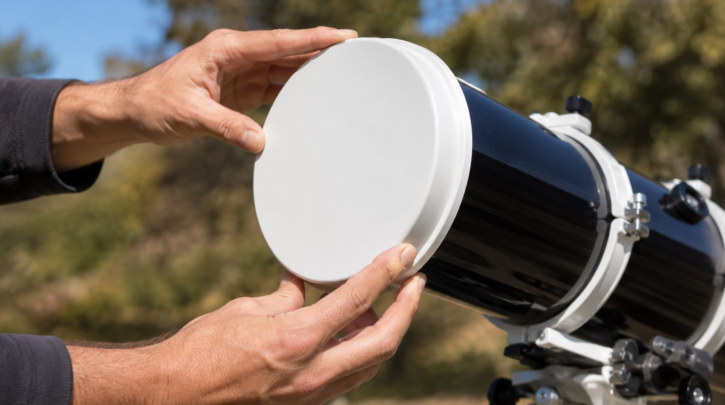

Choosing solar equipment starts with one non-negotiable rule: any filter must cover the full front aperture of a telescope, never the eyepiece end, and must be specifically certified for solar use. Beyond that baseline safety requirement, the choice comes down to white-light filters, a Herschel wedge, or a dedicated H-alpha telescope, each showing a different view.
Full-Aperture White-Light Filters
A full-aperture solar filter fits over the entire front opening of a telescope, blocking the vast majority of incoming light and heat before it enters the optical path at all — the safest possible design, since nothing inside the telescope ever handles unfiltered sunlight. These filters come in glass, which offers the best image quality and more durability at a higher price, and polymer film, which is lighter and less expensive but must be handled carefully to avoid punctures, even though minor wrinkles in the film don’t compromise safety.
The Herschel Wedge
A Herschel wedge is a prism-based accessory that diverts the vast majority of incoming sunlight out of the optical path before it reaches the eyepiece, used at the back of a refractor telescope rather than the front. It’s prized among visual observers for excellent image quality and contrast, but it’s only safe to use with refractor telescopes — reflector and compound telescopes have internal mirrors and baffles that would be damaged by the concentrated, unfiltered sunlight passing through the tube to reach a wedge at the back.
Dedicated H-Alpha Telescopes
Purpose-built H-alpha telescopes, from manufacturers like Coronado and Lunt, are designed from the ground up for solar viewing at that single narrow wavelength, revealing prominences and filaments that a white-light setup can’t show at all. These are a genuinely different, considerably more expensive category of equipment than adding a filter to an existing telescope, and they’re generally a dedicated purchase for solar observing specifically rather than a dual-purpose instrument.
Matching Gear to What You Want to See
| Setup | Shows | Relative Cost |
|---|---|---|
| Full-aperture white-light filter | Sunspots, granulation | Low |
| Herschel wedge (refractors only) | Sunspots, granulation, high contrast | Moderate |
| Dedicated H-alpha telescope | Prominences, filaments, flares | High |
Checking a Filter Before Every Use
Solar filters need the same pre-use inspection as eclipse glasses — checking for pinholes, tears, or damage to the filter material before every single session, not just the first time; see our safe viewing guide for the full inspection routine and why it matters every time, not just occasionally.
Securing the Filter Properly
A full-aperture filter needs to be securely attached so wind or an accidental bump can’t dislodge it mid-session — a filter that slips off while a telescope is pointed at the Sun is a serious hazard to anyone looking through the eyepiece at that moment. Checking that a filter is properly seated and secured, especially on a breezy day, is worth a deliberate habit before every single observing session.
Starting Small
For anyone new to solar observing, a full-aperture white-light filter added to an existing telescope is by far the cheapest and lowest-risk way to try the hobby before committing to a dedicated H-alpha instrument. Sunspots alone are genuinely rewarding, especially during an active part of the solar cycle, and they’re a reasonable place to start before deciding whether the more dynamic H-alpha view is worth the added cost; see our sunspot viewing guide for what to expect from that starting point.
Finder Scopes Need Attention Too
A telescope’s small finder scope, used to aim the main instrument, is not filtered by a front-aperture solar filter on the main tube and remains just as dangerous as an unfiltered telescope if left uncapped and pointed at the Sun. Capping or removing the finder scope entirely before a solar session, and aiming using the main telescope’s own shadow on the ground instead, avoids this often-overlooked hazard.
Cost Expectations
A basic film-based full-aperture filter sized for a common telescope aperture is one of the least expensive accessories in amateur astronomy, while glass filters and Herschel wedges cost meaningfully more, and a dedicated H-alpha telescope represents a genuinely significant investment comparable to a serious deep-sky telescope purchase. Matching the spend to how much solar observing you actually expect to do avoids overbuying before you know how much the hobby appeals to you.
Whatever you choose, the safety requirements stay identical across every price point — a cheap filter used correctly is exactly as safe as an expensive one.