
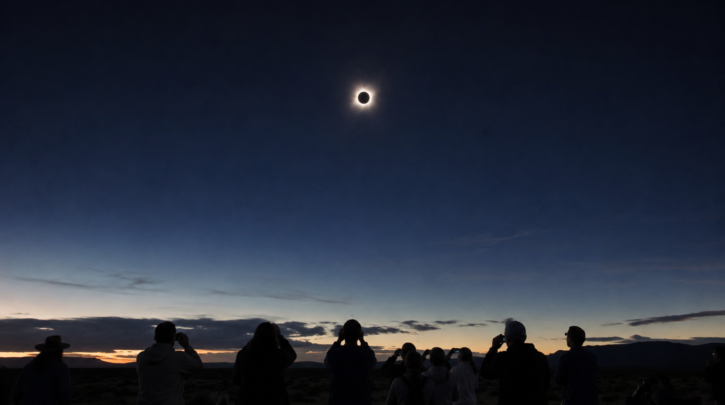

A total solar eclipse is arguably the single most dramatic sight in amateur astronomy — day briefly turning to twilight, the Sun’s corona blazing into view, and a crowd of onlookers reacting in real time. It’s also genuinely rare at any specific location, which is exactly why “eclipse chasing” — traveling to the path rather than waiting for one to come to you — is the norm among dedicated observers.
The Four Types of Solar Eclipse
A total eclipse occurs when the Moon fully covers the Sun’s disk, visible only within a narrow path of totality typically 100 to 250 kilometers wide. A partial eclipse, visible over a much wider surrounding region, shows the Moon covering only part of the Sun. An annular eclipse happens when the Moon is farther from Earth in its orbit and appears too small to fully cover the Sun, leaving a bright “ring of fire” visible around its edge even at maximum coverage. A hybrid eclipse, the rarest type, appears total along part of its path and annular along the rest, due to the curvature of the Earth relative to the Moon’s shadow.
Why Totality Is So Rare at Any One Spot
Total solar eclipses happen somewhere on Earth roughly every year or two, but for any specific location, totality is estimated to recur only about once every 375 years on average — the path of totality is simply too narrow relative to Earth’s surface for any one place to expect a repeat performance often. This is the entire reason eclipse chasing exists as a pursuit: waiting at home for totality to arrive isn’t a realistic strategy, while traveling to meet the path is; see our upcoming eclipses guide for where the next several paths of totality actually fall.
What Totality Actually Feels Like
As totality approaches, daylight dims rapidly over the final minutes, temperature noticeably drops, and the sky darkens to something like deep twilight rather than full night. Just before and after totality, a brief “diamond ring” effect appears as the last or first sliver of direct sunlight shines out beside the Moon’s silhouette, sometimes accompanied by Baily’s beads — points of sunlight shining through valleys on the Moon’s edge. During totality itself, the Sun’s normally invisible outer atmosphere, the corona, becomes visible as a pale, wispy halo, and bright stars and planets often appear in the darkened sky.
Solar Eclipse Frequency
Somewhere between two and five solar eclipses of some type occur around the world in a typical year, though most years include only partial or annular events rather than a total eclipse, and any single eclipse’s path only crosses a small fraction of the globe. This is why a dedicated eclipse chaser might travel internationally several times in a decade just to catch a handful of total eclipses, rather than treating them as a rare once-in-a-lifetime event tied to home.
Safety Comes Before Everything Else
Every phase of a solar eclipse except the brief total phase itself requires proper eye protection to view safely — this is genuinely important and not an exaggerated caution; see our eclipse safety guide before planning any eclipse viewing or photography at all.
Planning an Eclipse Trip
Because eclipse dates and paths are calculated with extreme precision years in advance — unlike weather or aurora activity, which carry real forecasting uncertainty — eclipse trips can be planned with confidence well ahead of time. The main planning risks are weather (cloud cover on the day itself) and crowds, since popular, accessible paths of totality can see overwhelmed local infrastructure, as happened in several small towns along the 2017 and 2024 US paths.
Photographing vs. Experiencing
Experienced eclipse chasers consistently advise against spending all of a brief totality — often only one to four minutes — fussing with camera settings and missing the chance to actually watch with your own eyes. Deciding in advance how much of totality you’ll dedicate to photography versus simply experiencing it is worth genuine thought before the day arrives; see our eclipse photography guide for a workflow that leaves real time for both.
Animals and Nature During an Eclipse
As daylight fades toward totality, wildlife and even domestic animals sometimes respond as though evening is arriving — birds may go quiet or head to roost, crickets can start calling, and some flowers that close at night have been observed closing early. These reactions vary and aren’t guaranteed at every eclipse, but they’re a genuinely interesting secondary thing to watch for beyond the sky itself.
Why Eclipse Chasing Has a Real Community
Eclipse chasing has developed a genuine community and even a semi-official vocabulary of its own — terms like “umbraphile” (literally “shadow lover”) describe people who travel specifically for the experience of totality, sometimes attending a dozen or more eclipses over a lifetime. That kind of dedication says a lot about how singular the experience is reported to be by people who’ve genuinely seen several.