

There are 88 officially recognized constellations, but you don’t need to know anywhere near all of them to start navigating the sky confidently. A handful of bright, easy-to-recognize patterns act as anchor points you can use to find everything else, and that’s the smarter place to start than trying to memorize the full list.
Constellations vs. Asterisms
A constellation is one of the 88 official regions of sky recognized by the International Astronomical Union, while an asterism is any recognizable star pattern that isn’t itself an official constellation — the Big Dipper, for example, is an asterism made up of seven stars within the larger constellation Ursa Major. Most of the patterns beginners learn first are actually asterisms, since they tend to be simpler and more recognizable than the full boundaries of their parent constellations.
Circumpolar Constellations: Visible Year-Round
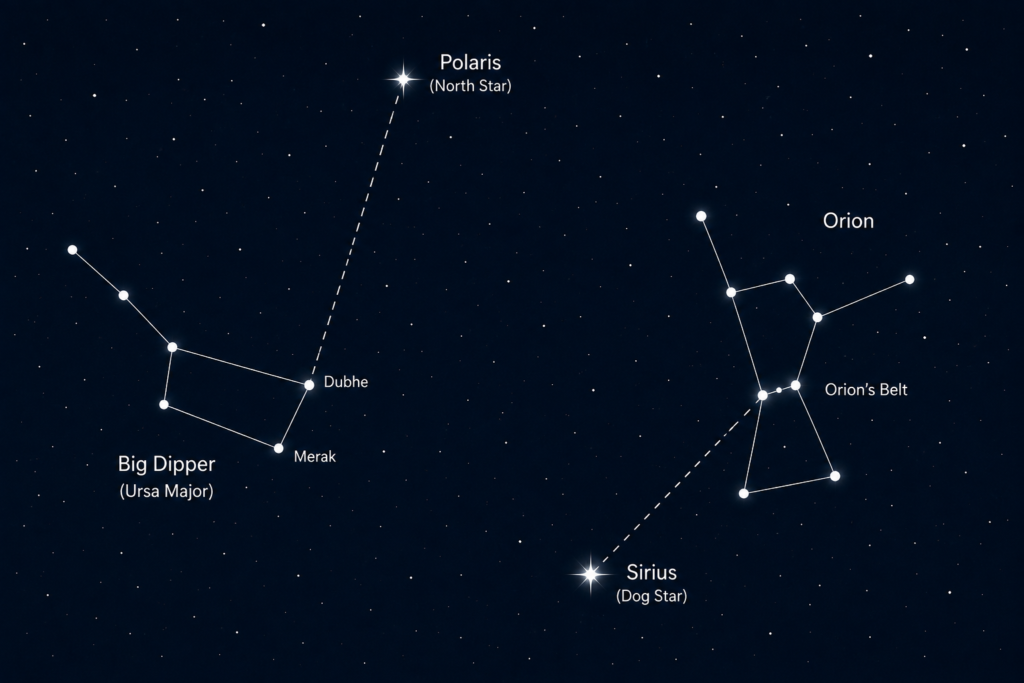
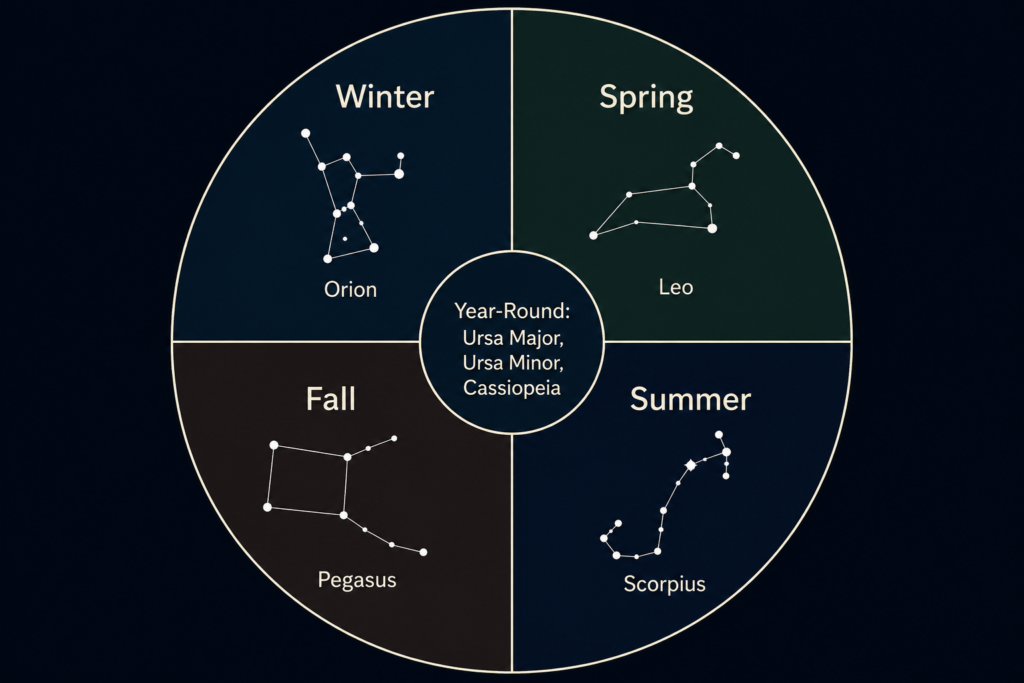
From mid-northern latitudes, a group of constellations near the North Star never sets below the horizon — they’re visible on any clear night, in any season, which makes them the best starting point. Ursa Major (home of the Big Dipper), Ursa Minor (home of the Little Dipper and Polaris), Cassiopeia (a distinctive W or M shape), Cepheus, and Draco all fall into this circumpolar category; see our North Star guide for how the Big Dipper points directly to Polaris.
Seasonal Constellations
Away from the circumpolar region, constellations rise and set with the seasons as Earth orbits the Sun. Orion, with its unmistakable three-star belt, dominates northern winter evenings. Leo, marked by a backward-question-mark shape, is a spring fixture. Scorpius, with a real curved-tail shape rare among constellations, rules summer skies (best seen from more southern latitudes). Pegasus’s Great Square anchors the fall sky. Learning which season you’re in narrows down what to look for considerably.
Using One Constellation to Find Another
Most constellation guides teach a system of “star-hopping” — using one known pattern to point toward the next. The Big Dipper’s two outer bowl stars point to Polaris; Orion’s belt, extended one direction, points to Sirius (the night sky’s brightest star) and the other direction to Aldebaran and the Pleiades cluster. Learning a few of these pointer relationships is far more useful than memorizing constellations in isolation, since it turns the sky into a connected map rather than a list of disconnected shapes.
A Simple Starting Set
| Constellation | Best Season (N. Hemisphere) | How to Spot It |
|---|---|---|
| Ursa Major | Year-round | Big Dipper’s distinctive ladle shape |
| Ursa Minor | Year-round | Little Dipper; Polaris at the handle’s end |
| Cassiopeia | Year-round | Bright W or M shape opposite the Big Dipper |
| Orion | Winter | Three-star belt in a straight line |
| Leo | Spring | Backward question mark plus a triangle |
| Scorpius | Summer | Curved tail, rare true scorpion shape |
| Pegasus | Fall | Great Square of four bright corner stars |
Southern Hemisphere Differences
Observers south of the equator see a genuinely different sky — the northern circumpolar constellations described above are partly or entirely invisible, replaced by their own circumpolar set including the Southern Cross and Carina. If you’re stargazing from the Southern Hemisphere, look for guides specific to that hemisphere rather than assuming northern constellation positions and seasons apply.
Reading a Chart to Confirm What You’re Seeing
Once you know roughly what to look for, a star chart or app oriented to your exact time and location confirms it and shows the fainter connecting stars that complete each pattern; see our how to read a star chart guide for getting a chart properly oriented to the sky in front of you.
Why Learning Constellations Still Matters With Go-To Tech
Even with an app or a smart telescope that finds targets automatically, knowing the constellations gives you context that pure technology doesn’t — an intuitive sense of where you are in the sky, what season it is just by looking up, and the ability to orient yourself instantly if your phone dies or a telescope’s go-to system loses alignment. It’s the difference between following directions and actually knowing your way around.
Learning at Your Own Pace
There’s no need to rush through all seven constellations in this guide in one night. Learning one or two circumpolar patterns first, and adding a new seasonal constellation every few weeks as it becomes prominent, builds familiarity naturally rather than through forced memorization. Most experienced stargazers didn’t learn the sky in a single sitting either — it accumulated gradually, session by session, over a season or two.
The payoff compounds too — each new constellation you learn makes the next one easier to place, since the sky stops being a blank field and starts being a map you’re steadily filling in.