
Sunspots are the most accessible target in solar observing — visible in even a modest, properly filtered telescope, genuinely rewarding to track over several days, and a direct, visible link to the Sun’s roughly 11-year activity cycle.
What Sunspots Actually Are
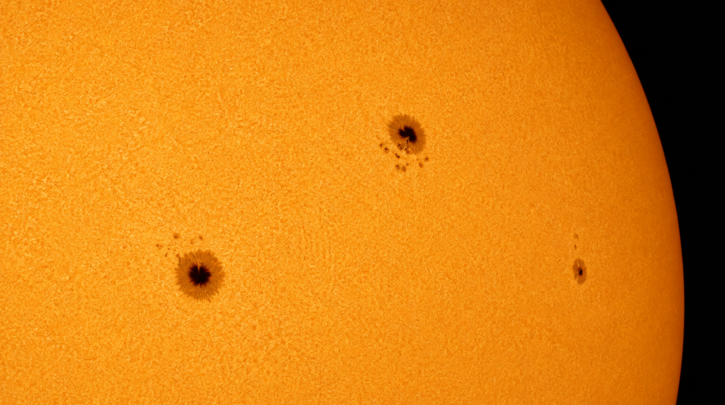
Sunspots form where concentrated magnetic field lines suppress the convection that normally carries heat to the surface, making that region cooler than the surrounding photosphere — still extremely hot in absolute terms, but cool enough by comparison to appear dark against the brighter surface around it. A typical sunspot shows a darker central region called the umbra surrounded by a lighter, textured penumbra, both visible with enough magnification and a steady atmosphere.
Sunspot Numbers and the Solar Cycle
Astronomers have tracked a running sunspot count for centuries, giving the solar cycle one of the longest continuously observed records in all of astronomy. Counts rise toward solar maximum, when multiple spots or spot groups may be visible at once, and fall toward solar minimum, when the disk can appear entirely blank for extended stretches; see our solar observation guide for how this cycle affects H-alpha activity as well.
Watching the Sun Rotate
Tracking a single sunspot’s position across several consecutive days reveals something genuinely remarkable: the Sun’s own rotation, visible directly through your own observations rather than as an abstract fact. A spot near the Sun’s equator crosses the visible disk in a little under two weeks, completing a full rotation in about 27 days as seen from Earth — and spots at higher solar latitudes take noticeably longer, since the Sun, being a ball of plasma rather than a solid body, rotates faster at its equator than near its poles, a phenomenon called differential rotation.
Sketching or Photographing Sunspot Groups
A simple daily sketch of visible sunspot groups, or a quick photo through a properly filtered setup, builds a personal record of solar activity over time and makes the rotation and evolution of spot groups easy to compare day to day; see our astrophotography camera guide for the same manual camera fundamentals applied to a solar filter setup instead of a night-sky target.
Group Viewing With Projection
For sharing sunspots with a group — a classroom, a family, a public outreach event — projecting the Sun’s image through a small telescope or one side of a pair of binoculars onto a white card gives everyone a clear, safe, shared view at once, without needing multiple filtered eyepieces or individual eclipse glasses for each viewer. This projection method shows sunspots clearly and is completely safe, since no one looks directly through the eyepiece at any point; see our safe viewing guide for how to set this up correctly.
What Counts as an Active Sunspot Session
Even a single well-formed sunspot group is worth a session, especially viewed at enough magnification to make out the umbra-penumbra structure clearly. During a quiet stretch of the solar cycle, patience matters — an entirely blank disk on a given day doesn’t mean the equipment or technique is wrong, just that solar activity happens to be low at that point in the cycle.
Historical Sunspot Records
Continuous sunspot records stretch back centuries, including observations by early telescope users like Galileo, giving solar physicists an unusually long-term dataset for studying the Sun’s behavior compared to almost any other astronomical phenomenon. Modern amateur sunspot counts, submitted to organizations that track this data, genuinely contribute to that same long-running record, which is a rare case of a backyard hobby directly feeding real scientific data collection.
Sunspot Groups and Naming
Active sunspot regions are cataloged and numbered by professional solar observatories as they form, persist, and eventually fade over days to weeks, which gives amateur observers a way to look up whether a specific spot they’re tracking has an official designation and how it’s expected to evolve. Following a numbered active region through its full visible lifecycle, from formation to rotating off the disk, adds an extra layer of context to routine sunspot watching.
Even a casual observer can benefit from this same context, turning a quick look at a spot into an ongoing story followed across an entire week or two.