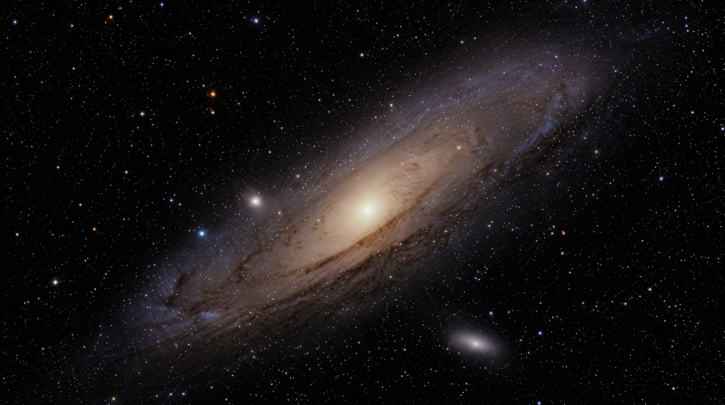

The Andromeda Galaxy, cataloged as M31, is the most distant object visible to the unaided human eye — roughly 2.5 million light-years away, and still bright enough to spot as a faint smudge under a reasonably dark sky. Finding it reliably comes down to a simple, repeatable star-hop from a couple of well-known constellations.
Best Time of Year
From the Northern Hemisphere, Andromeda is best placed in fall, when it sits high overhead during convenient evening hours, though it’s visible for a good stretch of the year around that peak season. Checking a planetarium app or star chart for its current position and height above the horizon avoids wasted searching outside its good viewing window; see our stargazing apps guide for tools that show this.
Star-Hopping From Cassiopeia
Cassiopeia’s distinctive W (or M) shape is a reliable starting point — one of its outer points roughly aims toward the general direction of Andromeda, giving a rough starting bearing before narrowing in with the constellation Andromeda itself; see our constellation guide for finding Cassiopeia in the first place.
Star-Hopping From the Great Square of Pegasus
A more precise route starts from the Great Square of Pegasus, a large, easily recognized shape of four corner stars. From the square’s upper-left corner star, two chains of stars extend outward marking the constellation Andromeda; following the brighter chain to its second star (called Mirach), then turning roughly 90 degrees and hopping through two fainter stars, lands almost exactly on the galaxy’s position. This route is more involved than the Cassiopeia shortcut but more reliable once practiced.
Confirming You’ve Found the Right Object
A common beginner worry is mistaking a random faint star or haze for the actual galaxy. The real giveaway is shape and consistency — Andromeda appears as a distinctly elongated, oval glow with a noticeably brighter center, not a simple round point like a star, and it stays in that same position relative to the surrounding star pattern every time you look, unlike atmospheric haze or a lens artifact that might otherwise cause doubt.
What You’ll See at Each Equipment Level
To the naked eye under a dark sky, Andromeda appears as a faint, elongated smudge, easy to miss if you’re not sure exactly where to look. Binoculars show a clearly oval glow with a noticeably brighter core. A telescope reveals more of the extended disk and, under good dark-sky conditions with enough aperture, its two brighter companion galaxies, M32 and M110, as smaller smudges nearby.
Why It Looks Like a Smudge, Not a Spiral
Andromeda’s famous spiral structure, familiar from photographs, isn’t realistically visible through a traditional eyepiece at any amateur aperture — the galaxy is simply too faint and extended for the eye to resolve that level of structure in real time, even though the light is genuinely there. This is one of the more common disappointments for first-time observers, and it’s a normal limit of visual observing rather than a sign of inadequate equipment.
Where Smart Telescopes Change the Picture
This is exactly the kind of target where live image stacking makes a visible difference — a smart telescope pointed at Andromeda for several minutes can reveal genuine hints of dust lanes and structure well beyond a simple oval glow, approaching what a long-exposure photograph shows rather than a faint traditional eyepiece view. Given that Andromeda is one of the most requested deep-sky targets in amateur astronomy, it’s also one of the best demonstrations of what that technology adds; see our deep-sky observing guide for how that stacking process works.
See Andromeda’s structure revealed through live stacking View Unistellar smart telescopes
A Good First Deep-Sky Target
Andromeda’s combination of naked-eye visibility, a genuinely findable location once you know the star-hop, and real reward at every equipment level makes it one of the best deep-sky objects for a beginner to master early. Successfully finding it under your own power is also a solid confidence builder before moving on to fainter, less naked-eye-friendly galaxies.
Andromeda’s Place in the Bigger Picture
Andromeda is the largest member of the Local Group, the small cluster of galaxies that includes our own Milky Way, and it’s currently approaching us, expected to eventually merge with our galaxy several billion years from now — a genuinely vast timescale, but a neat piece of context for an object that’s otherwise easy to treat as just another faint smudge in the eyepiece.
Few objects pack that much history, scale, and observing reward into a single evening’s search.