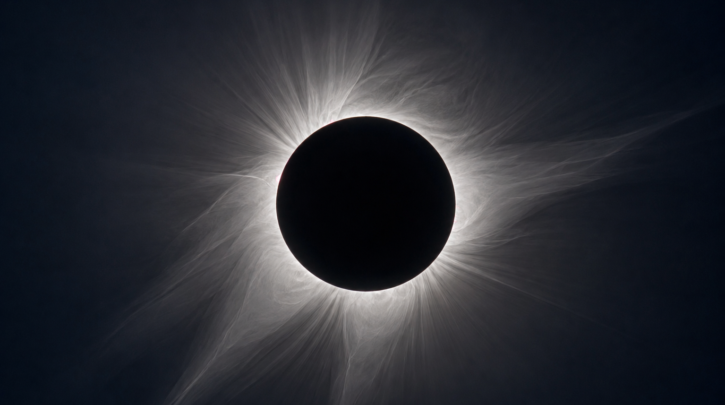

Unlike aurora activity or weather, which carry real forecasting uncertainty even a few days out, solar eclipse timing and paths are calculated with extreme precision using orbital mechanics, often published accurately decades or even centuries in advance. That predictability makes eclipse trip planning fundamentally different from anything else on this site — you can commit to a specific date and location with real confidence, weather permitting on the day itself.
Confirmed Upcoming Total Solar Eclipses
| Date | Path of Totality | Approx. Max Duration |
|---|---|---|
| August 12, 2026 | Arctic, Greenland, Iceland, northern Spain, Portugal | ~2 min |
| August 2, 2027 | Morocco, Spain, Algeria, Tunisia, Libya, Egypt, Saudi Arabia, Yemen, Somalia | ~6 min 22 sec |
| July 22, 2028 | Australia, New Zealand | ~5 min 10 sec |
| November 25, 2030 | Namibia, Botswana, South Africa, Lesotho, Australia | varies by location |
The 2027 Eclipse’s Unusual Duration
The August 2, 2027 eclipse stands out for an exceptionally long totality — over six minutes at its longest point, among the longest of the 21st century — which happens when the timing of the Moon’s orbit brings it unusually close to Earth (making its shadow larger) near the same time the eclipse occurs. Its path crosses through Egypt, including areas near significant historical sites, which has already made it a heavily anticipated event among dedicated eclipse chasers.
Next Total Eclipses Visible From North America
After the April 8, 2024 total eclipse that crossed Mexico, the United States, and Canada, the next total solar eclipse visible from North America occurs on March 30, 2033, with its path crossing Alaska. Following that, the US mainland sees total eclipses again in 2044 and 2045, with the 2045 path covering a notably broad swath of the country from California to Florida.
Annular Eclipses Along the Way
Beyond total eclipses, annular “ring of fire” eclipses occur on February 6, 2027 (visible from Chile, Argentina, and the Atlantic) and January 26, 2028 (visible from Ecuador, Peru, Brazil, and parts of Spain and Portugal). These don’t offer the naked-eye totality experience of a total eclipse, since the Sun is never fully covered, but they’re still a genuinely striking sight and require the same certified solar filter protection throughout, with no safe unfiltered viewing window at any point.
Why Checking Official Sources Still Matters
While the dates and general paths above are well-established astronomical predictions, precise local circumstances — exact timing for a specific town, duration at a specific spot within the path, and local weather-pattern history — are worth checking against a dedicated resource like NASA’s eclipse pages or a specialized eclipse-mapping site closer to any specific trip, since these tools let you check exact circumstances for your planned viewing location down to the minute.
Planning Ahead for Popular Paths
Accessible, well-publicized eclipse paths — like the 2024 US eclipse or the 2026 Iceland and Spain path — can see local lodging and transportation booked up well over a year in advance, a pattern worth planning around rather than assuming last-minute arrangements will work out; see our travel packing guide for broader trip preparation that applies to eclipse travel as much as any other astronomy trip.
Building a Long-Term Eclipse List
Serious eclipse chasers often maintain a running list of upcoming eclipses years out, weighing factors like path accessibility, typical weather odds at that time of year, and total duration when deciding which trips are worth committing to. Given how far in advance eclipses are known, there’s no real reason to plan only one trip at a time rather than mapping out a multi-year eclipse-chasing calendar from the start.
Weather Odds Still Matter Most
With the date and location locked in with astronomical precision, weather on the actual day becomes the single biggest remaining variable — some eclipse paths cross regions with historically much better clear-sky odds for that time of year than others, which is a genuine factor worth researching before choosing exactly where along a path to position yourself, since even a short distance can mean meaningfully different typical weather patterns.
Why This Table Isn’t the Final Word
Eclipse predictions this far out are extremely reliable, but always confirm specifics against a dedicated, current eclipse-mapping resource before finalizing travel plans, since exact local circumstances and any updates to path calculations are best confirmed close to the date from an authoritative, continuously maintained source rather than a static table.
Treat the dates here as a reliable starting point for planning, and the official sources as the final word once a specific trip gets close.