
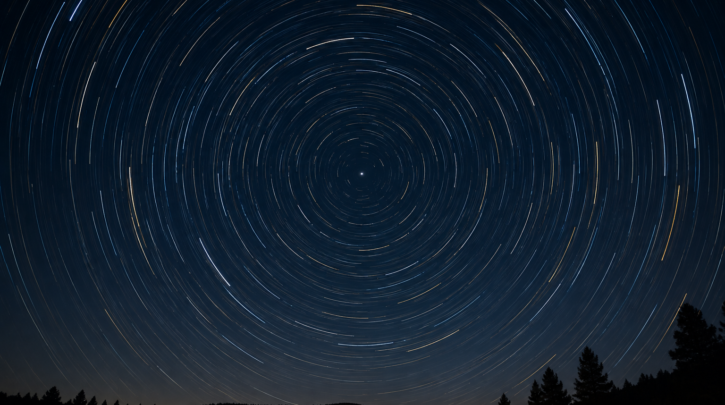

Polaris, the North Star, sits almost exactly above Earth’s north pole, which makes it appear nearly motionless while every other star in the northern sky wheels around it over the course of a night. It’s a useful landmark and a genuine navigation tool, even though it’s nowhere near the brightest star in the sky — a common misconception.
Polaris Isn’t Especially Bright
At around magnitude 2.0, Polaris is a moderately bright star, easily visible to the naked eye but far dimmer than showstoppers like Sirius or Vega. Its importance comes entirely from position, not brightness — it happens to sit almost exactly along Earth’s rotational axis, roughly 0.7 degrees from the true north celestial pole, which is why it appears to barely move while everything else rotates around it.
Finding It With the Big Dipper
The most reliable way to find Polaris is through the Big Dipper, an asterism within Ursa Major that’s visible year-round from most of the Northern Hemisphere. The two stars forming the outer edge of the Dipper’s “bowl” — Dubhe and Merak, often called the pointer stars — form a line that, extended roughly five times the distance between them, lands almost exactly on Polaris. Once you’ve done this once, it becomes an easy habit; see our constellation guide for other circumpolar patterns near it.
Why Everything Seems to Rotate Around It
Polaris’s near-motionless position isn’t an illusion — it’s a direct consequence of Earth’s rotation on its axis. Because Polaris sits so close to the point that axis points toward in the sky, Earth’s spin makes every other star appear to trace a circle around that fixed point over the course of a night, an effect beautifully visible in long-exposure star-trail photographs centered on Polaris.
Using Polaris to Find Your Latitude
Polaris has a practical use beyond navigation: the angle between the horizon and Polaris, measured in degrees, roughly equals your latitude on Earth. An observer at 40 degrees north latitude will find Polaris sitting about 40 degrees above the northern horizon. This relationship has been used for celestial navigation for centuries and is still a neat, low-tech way to estimate your latitude with nothing more than a rough angle measurement.
No Equivalent Star for the Southern Hemisphere
There’s no bright southern counterpart to Polaris — the star nearest the south celestial pole, Sigma Octantis, is far too faint to be useful for naked-eye navigation. Southern Hemisphere observers instead use the Southern Cross, extending its long axis roughly 4.5 times to estimate the direction of the south celestial pole, a different but comparably reliable method.
Polaris Isn’t Perfectly Fixed
Over long timescales, Polaris’s role as the North Star is temporary. Earth’s axis slowly wobbles over about 26,000 years in a process called precession, which means different stars have served as the pole star throughout history and will again in the future — Polaris just happens to be the current, conveniently bright occupant of that role for our era.
Historical Pole Stars
Around 5,000 years ago, the star Thuban in the constellation Draco served as the pole star, which is reflected in some ancient Egyptian monument alignments built to point toward it. In roughly 12,000 years, precession will bring the bright star Vega into the pole-star role, a considerably brighter marker than Polaris. These long, slow shifts are a good reminder that the sky beginners learn today is a temporary snapshot rather than a fixed, unchanging pattern.
Using Polaris for Photography
Polaris is also the standard reference point for star-trail photography and for polar-aligning an equatorial telescope mount, since aiming a mount’s axis at Polaris lets it track the sky’s rotation smoothly for long-exposure astrophotography; see our astrophotography guide for how polar alignment fits into a basic imaging setup.
A Quick Field Check
Once you’ve located Polaris using the Big Dipper’s pointer stars, a fast way to confirm you have the right star is to watch it over an hour or two — unlike every other star in view, it will have barely moved, while stars elsewhere in the sky visibly shift position. That near-total stillness is the single best confirmation you’re looking at the right point in the sky.
Once you can find Polaris reliably, orienting yourself under any night sky becomes second nature — it’s one of the very few sky-navigation skills that, once learned, never needs relearning.