
Five planets — Mercury, Venus, Mars, Jupiter, and Saturn — are visible to the naked eye without any equipment at all, and have been observed since antiquity long before telescopes existed. Knowing when and where to look, and how to tell a planet from an ordinary star, turns planet watching from a lucky accident into something you can plan and rely on.
How to Tell a Planet From a Star
Planets typically shine with a steadier light than stars, which twinkle noticeably due to atmospheric turbulence bending the light from their effectively point-like sources. Planets, being close enough to show a tiny but real disk rather than a true point of light, average out that turbulence and appear calmer. The other reliable tell is movement over time — the word “planet” comes from the Greek for “wanderer,” since ancient observers noticed these lights slowly shifting position against the fixed background stars over days and weeks, unlike everything else in the sky.
Inferior Planets: Mercury and Venus
Mercury and Venus orbit closer to the Sun than Earth does, which means they never stray far from it in the sky and are only visible during a window shortly after sunset or before sunrise — never in the middle of the night. Venus is the brightest planet by far, often called the “morning star” or “evening star” depending on which side of its orbit it’s currently on, while Mercury is trickier: low on the horizon and often lost in twilight glow, best caught during its periodic best viewing windows, called greatest elongations.
Superior Planets: Mars, Jupiter, and Saturn
Mars, Jupiter, and Saturn orbit farther from the Sun than Earth, which means they can appear anywhere in the night sky and, at their best, are visible all night long around a point called opposition, when Earth sits directly between the planet and the Sun. Mars shows an unmistakable reddish-orange color to the naked eye; Jupiter is the second-brightest planet after Venus and easy to spot once you know where to look; Saturn is dimmer but still a clear, steady point of light, with its famous rings only visible through a telescope.
Naked Eye vs. Binoculars vs. Telescope
The naked eye is enough to identify all five bright planets and notice Venus and Mars’s brightness and color. Binoculars add a real upgrade — Jupiter’s four largest moons become visible as tiny points of light alongside the planet, and Venus’s phases become just barely detectable in steady hands. A telescope is where the real detail appears: Saturn’s rings, Jupiter’s cloud bands, and enough resolution to make out Mars’s polar ice caps under good conditions; see our planetary telescope guide for what to look for in a scope built for this.
Timing: Opposition and Elongation
For the outer planets, opposition — when Earth passes between the planet and the Sun — is the best viewing window, since the planet is both closest to Earth and up all night. Mars reaches opposition roughly every 26 months, Jupiter about every 13 months, and Saturn about every 12.5 months. For Mercury and Venus, the equivalent best-viewing marker is greatest elongation, the point in their orbit where they appear farthest from the Sun in the sky; see our visibility calendar guide for how to check current timing for each planet.
Jupiter’s Moons and Saturn’s Rings
Two of the most rewarding planetary sights are accessible at very different equipment levels. Jupiter’s four Galilean moons are visible in almost any binoculars steadied against something solid; see our Jupiter’s moons guide for what to expect. Saturn’s rings need an actual telescope, even a modest one, at moderate magnification; see our Saturn’s rings guide for the magnification and conditions that make the difference.
Realistic Expectations
Naked-eye and binocular planet watching is genuinely rewarding on its own — recognizing Jupiter or Venus at a glance, watching Mars redden as it approaches opposition — without needing a telescope at all. A telescope adds a different tier of detail, but it’s worth enjoying the naked-eye version first rather than assuming nothing is worth seeing until you own a telescope.
Planetary Groupings and Conjunctions
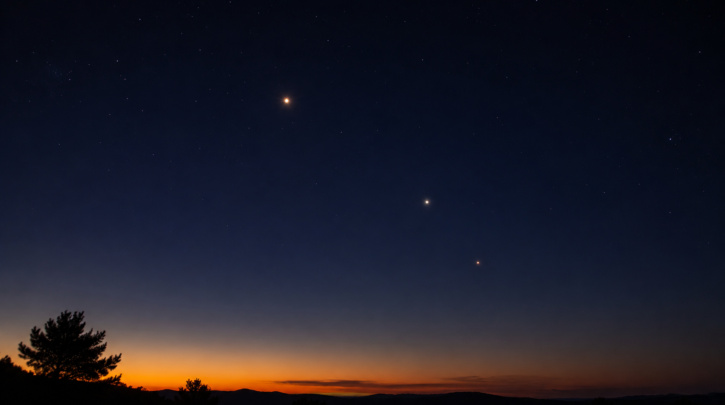
Occasionally two or more planets appear close together in the sky as seen from Earth, an event called a conjunction, even though the planets themselves remain enormously far apart in actual space. These groupings are naked-eye spectacles worth watching for, and a planetarium app will flag upcoming ones well in advance; see our visibility calendar guide for the tools that track this.
Uranus and Neptune
Beyond the five classical naked-eye planets, Uranus sits right at the edge of naked-eye visibility under an excellent dark sky, appearing as an extremely faint point that’s easy to miss without knowing exactly where to look. Neptune is fainter still and genuinely requires binoculars or a telescope and an accurate star chart to distinguish it from the surrounding field of stars, since it never appears as anything more than a dim, star-like point even through a telescope.