
The most important beginner telescope lesson has nothing to do with brand or price: aperture — the diameter of the main lens or mirror — determines how much light a telescope gathers, and that matters far more than magnification. A telescope marketed on high magnification numbers with a small aperture will produce dim, blurry views no matter how the box describes it.
Aperture Over Magnification
Magnification is a function of eyepiece choice and can be pushed arbitrarily high on any telescope, but past a certain point it just makes a dim, blurry image bigger and blurrier. Aperture is what actually determines how much detail and how many faint objects are visible, since a larger mirror or lens gathers more light. A cheap telescope advertising “650x magnification” with a tiny 50mm aperture will disappoint every time — a modest 6-inch reflector at a reasonable magnification will show far more.
Refractor Telescopes
Refractors use a lens at the front to gather light and are simple, sealed designs with very little maintenance — no mirror alignment to worry about. They’re excellent for the Moon and planets and tend to produce sharp, high-contrast views, but a large-aperture refractor gets expensive fast, which is why most budget refractors stay on the smaller side.
Reflector and Dobsonian Telescopes
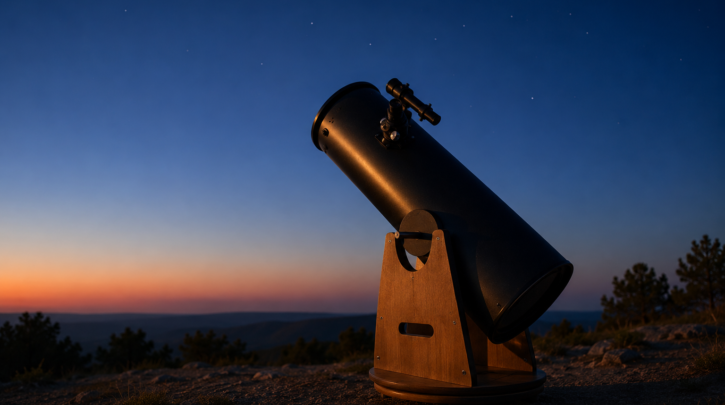
Reflectors use a mirror instead of a lens, which makes large apertures far more affordable than an equivalent refractor. Dobsonian telescopes — reflectors on a simple, sturdy rocker-box mount — are frequently recommended as the best value in traditional telescopes, since they maximize aperture per dollar and are refreshingly simple to set up and aim, even if they require occasional mirror alignment (collimation) to stay sharp.
Smart Telescopes: Skipping the Learning Curve
Smart telescopes represent a genuinely different category rather than just another design. Models like the Unistellar Odyssey and eVscope 2 use an app-controlled go-to system to find and track targets automatically, and computational image stacking to build up a bright, detailed view of faint deep-sky objects in real time — something that’s traditionally required a separate camera, tracking mount, and processing software to achieve. This also means they perform meaningfully better from light-polluted skies than a traditional telescope of similar size, since the stacking process can partially filter out sky glow.
See how a smart telescope simplifies getting started View the Unistellar Odyssey
The Real Tradeoff With Smart Telescopes
The catch is price — smart telescopes start around $2,000 and climb from there, well above a traditional beginner Dobsonian in the $200 to $400 range. What you get for the difference is a dramatically shorter learning curve, genuinely photo-worthy views of deep-sky objects without separate astrophotography gear, and usable results even from a bright suburban backyard. For someone who wants immediate, rewarding results and doesn’t mind the cost, that tradeoff is genuinely worth considering rather than a beginner-only afterthought.
Binoculars as a Real Alternative
Before any telescope, a pair of 7×50 or 10×50 binoculars remains a legitimate first purchase — cheaper, no setup, and genuinely useful for years even after you own a telescope; see our stargazing basics guide for why binoculars are often the better first step.
Matching a Telescope to Your Actual Interest
If planets and the Moon are the main draw, a modest refractor or reflector handles that well at a low price point. If faint deep-sky objects — galaxies and nebulae — are the goal, aperture becomes more important, which favors a larger Dobsonian or a smart telescope’s stacking capability. Being honest about what you actually want to look at, rather than buying the most impressive-looking box, is the single best way to avoid an expensive mistake.
Mount Type Matters as Much as Optics
A great optical tube on a shaky, hard-to-aim mount is a frustrating combination that turns people off the hobby fast. Simple alt-azimuth mounts (moving up-down and left-right, like a camera tripod) are the easiest for beginners to use intuitively, while equatorial mounts, designed to track the sky’s rotation for astrophotography, have a steeper learning curve. A Dobsonian’s simple rocker-box mount is a big part of why it’s such a popular beginner recommendation — point it where you want to look, and it stays put.
Buying Used or Starting Small
A quality used telescope from a local astronomy club or a reputable secondhand marketplace can be a genuinely good value, since telescopes don’t wear out the way many other hobby purchases do. For anyone still unsure how serious they’ll get about the hobby, starting with binoculars or a modest, inexpensive telescope before committing to a smart telescope’s higher price point is a reasonable, low-risk way to find out.