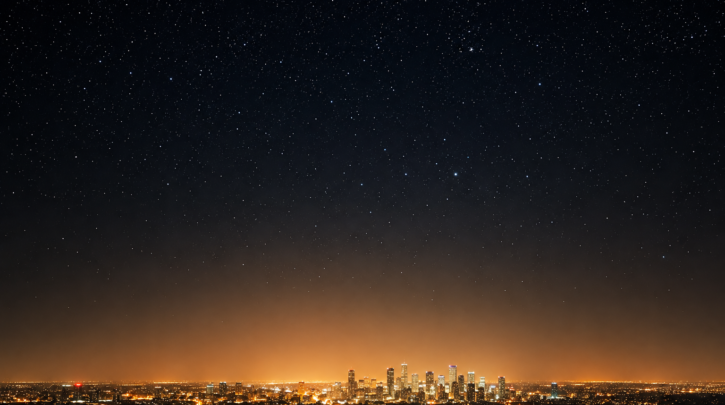

Light pollution changes what’s visible in the night sky, but it doesn’t end stargazing — the Moon, planets, and brightest stars remain visible from even a fairly bright city, while fainter objects like galaxies and nebulae need genuinely dark conditions or, increasingly, a smart telescope that can partially compensate.
The Bortle Scale, Briefly
Astronomers rate sky darkness on the Bortle scale, running from Class 1 (the darkest skies on Earth) to Class 9 (inner-city skies where only the Moon, planets, and a handful of the brightest stars are visible). Most suburban skies fall around Class 5 to 7, while a short drive to a rural area can drop you into Class 3 or 4; see our full breakdown at our Bortle scale guide for what changes at each level.
What’s Still Visible From a City
Even from a bright Class 8 or 9 city sky, the Moon shows full detail, bright planets like Venus, Jupiter, and Saturn remain easy targets, and a couple dozen of the brightest stars and constellation outlines stay visible. The International Space Station, when it’s passing overhead, is bright enough to see clearly from almost anywhere. City stargazing is real and worthwhile — it’s just a different, more limited version of the hobby.
What Needs a Dark Sky
The Milky Way’s band, faint nebulae, and most galaxies beyond a short list of the brightest ones require meaningfully darker skies than most people live under — typically Class 4 or darker for a decent Milky Way view, and Class 3 or better for it to really stand out. This is the main reason serious deep-sky observers travel to dedicated dark-sky sites; see our dark-sky destinations guide for where those trips typically go.
Simple Ways to Improve Your Own Sky
- Turn off or shield nearby lights, including your own porch light, during a session
- Move to the darkest spot available to you, even if it’s just the far corner of a yard or a local park after hours
- Block direct light sources with your body, a hood, or a dark cloth rather than fighting the whole sky’s glow at once
- Check a light pollution map online to find the nearest meaningfully darker sky before planning a trip
How Smart Telescopes Change the Equation
Smart telescopes with computational image stacking, like Unistellar’s eVscope and Odyssey lines, can partially filter out the sky glow that light pollution creates, revealing galaxies and nebulae from a backyard that would show nothing through a traditional telescope of similar size. This doesn’t fully replace a genuinely dark sky — contrast and detail are still better under dark conditions — but it meaningfully narrows the gap for anyone stuck observing from a bright suburb or city; see our beginner telescopes guide for how that technology works.
See a telescope built for light-polluted skies View the Unistellar Odyssey
Advocacy and Long-Term Change
Beyond personal workarounds, light pollution is a solvable problem at a community level — shielded, downward-facing fixtures and lower-intensity lighting reduce sky glow without sacrificing safety, and organizations like the International Dark-Sky Association (now DarkSky International) work with towns to adopt these standards. Supporting or simply learning about these efforts is a longer-term way to improve the sky for an entire community, not just a single stargazing session.
Measuring Your Own Sky
Rather than guessing, a naked-eye limiting-magnitude check — counting the faintest stars you can see in a familiar constellation and comparing against a reference chart — gives a rough, personal Bortle estimate for your own backyard. Online light pollution maps offer a broader, satellite-data-based estimate for any location, which is useful for comparing your home sky against potential trip destinations before you travel.
Light Pollution Changes Over Time
A location’s light pollution isn’t fixed forever — new development can make a previously decent sky noticeably worse over a few years, while community dark-sky initiatives and lighting ordinance changes can meaningfully improve one. It’s worth reassessing a regular observing spot every so often rather than assuming conditions are unchanged from when you first started using it.
Whatever your local conditions, knowing exactly what they allow — rather than assuming the worst or expecting more than the sky can deliver — is what actually makes for a satisfying night out.