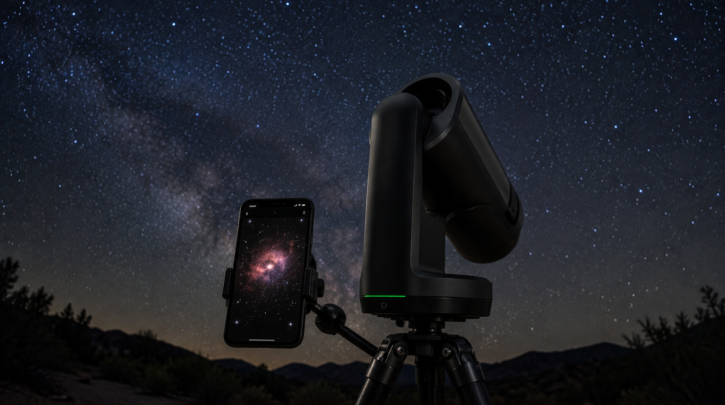

Smart telescopes replace the traditional deep-sky astrophotography stack — telescope, tracking mount, guide scope, dedicated camera, and stacking software — with a single automated unit that finds a target, tracks it, and builds up a stacked image in real time through an app. For anyone who wants genuine deep-sky results without years of learning traditional imaging, this is currently the fastest path there.
How Smart Telescope Imaging Works
Rather than a single long exposure, a smart telescope captures a continuous series of shorter exposures, automatically aligns each new one against the growing stack, and adds it in — building up signal and revealing fainter detail the longer you leave it running on a target. This live-stacking approach means you can watch a faint galaxy or nebula gradually brighten and sharpen on your phone screen over a few minutes, rather than waiting until after the session to process anything.
Unistellar’s Lineup
Unistellar’s Expert range — the eVscope 2 and eQuinox 2 — targets more serious users with larger apertures and higher resolution, while the Discovery range — the Odyssey and Odyssey Pro — is lighter, more portable, and priced as a more accessible entry point starting around $2,299. The Odyssey Pro adds a digital eyepiece jointly developed with Nikon, letting you view the live-stacked image directly through an eyepiece rather than only on a connected phone or tablet.
Compare the current Unistellar lineup View Unistellar smart telescopes
How This Compares to Other Smart Telescopes
Unistellar isn’t the only player in this category — Vaonis, with its Vespera line, offers a similar automated stacking approach in a different form factor. Across brands, the core value proposition is the same: automated target selection, tracking, and stacking that replaces a much larger and more complex traditional setup. Differences tend to come down to aperture, resolution, app ecosystem, and physical design rather than a fundamentally different approach to the imaging itself.
What You Give Up for the Convenience
Smart telescopes trade some flexibility for their ease of use — you’re generally working within the manufacturer’s app and processing pipeline rather than having full manual control over every exposure and calibration frame the way a traditional astrophotography rig allows. Serious imagers chasing the absolute best possible result on a single target may still prefer a manual rig with full control, but for the large majority of people who want genuinely good images without years of learning, that tradeoff is a reasonable one.
Performance in Light-Polluted Skies
A meaningful practical advantage of smart telescopes is that the stacking process helps filter out the sky glow of light pollution, producing usable deep-sky images from a suburban or even city backyard that would show little to nothing through a similarly sized traditional telescope. This matters more for astrophotography specifically than for casual visual observing, since a photographed and stacked image reveals detail your eye alone never would; see our light pollution guide for how much that gap actually closes.
Is It Worth the Price Difference
Building an equivalent traditional deep-sky imaging setup — telescope, equatorial mount, guide scope, dedicated astronomy camera, and stacking software licenses — can easily cost as much as or more than a smart telescope once every piece is accounted for, before factoring in the time spent learning to use it all well. For anyone prioritizing results and time over the process of building and mastering a manual rig, a smart telescope is genuinely a value proposition, not just a convenience premium.
The Citizen Science Angle
Unistellar telescopes also connect to active citizen-science programs run in partnership with the SETI Institute and NASA, letting owners contribute real observational data on asteroid occultations, exoplanet transits, and planetary defense tracking. This is a genuinely different value proposition than a traditional rig offers out of the box — the same device used for casual backyard imaging can also feed into professional research when its owner chooses to participate.
Choosing Between the Expert and Discovery Ranges
The choice between Unistellar’s larger Expert-range telescopes and the lighter Discovery-range Odyssey models mostly comes down to aperture versus portability. The Expert range gathers more light and resolves more detail on faint targets, while the Discovery range’s smaller size and lower weight make it considerably easier to pack for travel to a dark-sky site, which matters a great deal if trips away from home are a regular part of your plans; see our dark-sky destinations guide for the kind of travel that portability question comes up for.
Whichever range you choose, the underlying value is the same: a single device replacing what used to require a truckload of separate equipment and years of practice to operate well.