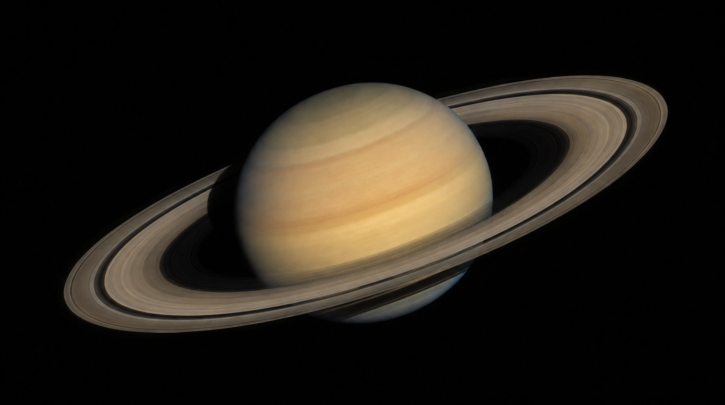

Saturn’s rings are one of the most requested sights in amateur astronomy, and one of the most satisfying to actually deliver on — but they need a real telescope, not binoculars, and a bit of understanding about magnification and timing to see well.
Why Binoculars Aren’t Enough
Through standard binoculars, Saturn appears as a slightly elongated, non-round point of light rather than a planet with visible rings — the rings are there, but binocular magnification isn’t high enough to resolve them into a recognizable shape. A telescope at roughly 25 to 50 times magnification is the practical minimum for the rings to clearly separate from the planet’s disk and look unmistakably like rings rather than an odd blur.
Magnification and Aperture
A small telescope in the 60mm to 90mm range at 25x to 50x will show the rings clearly as a distinct structure. A 4-inch or larger telescope at 100x to 150x, under steady atmospheric conditions, starts to reveal the Cassini Division — a dark gap within the rings — along with subtle shading and color variation across the ring system. Beyond a certain point, atmospheric steadiness (called “seeing” by astronomers) limits detail more than raw magnification does.
The Ring Tilt Cycle
Saturn’s rings aren’t always tilted the same way from Earth’s perspective. Over Saturn’s roughly 29.5-year orbit, the ring plane’s tilt relative to Earth cycles from wide open to nearly edge-on (when the rings can become very difficult to see, sometimes appearing as a thin line or nearly vanishing) and back again, with edge-on ring-plane crossings occurring roughly every 13 to 15 years. Because this cycle is ongoing, it’s worth checking current ring tilt with a planetarium app before a planned Saturn-viewing session, since the view genuinely varies year to year rather than staying constant.
Best Time to Observe
Saturn is best observed when it’s highest in the sky and farthest from the horizon’s hazy, turbulent air, which generally means observing as close to local midnight as practical, or whenever the planet is due south (for Northern Hemisphere observers) and at its highest point. Around opposition, when Saturn is up all night and at its closest approach to Earth for the year, both brightness and apparent size peak; see our visibility calendar guide for how to check when that is.
Titan and Saturn’s Other Moons
Titan, Saturn’s largest moon, is bright enough to spot as a star-like point near the planet in even a modest telescope, and it’s the most reliable of Saturn’s moons to catch without specialized equipment. Several fainter moons become visible in larger telescopes under dark, steady conditions, though they require more aperture and patience than Titan does.
Why a Tracking Mount Helps So Much
At the magnification needed to really appreciate the rings, Saturn drifts out of a telescope’s field of view within a minute or two due to Earth’s rotation, which means constant small adjustments on a manual mount. A tracking mount — including the kind built into smart telescopes — keeps the planet centered automatically, letting you actually settle in and study the rings rather than repeatedly nudging the telescope back on target; see our planetary telescope guide for how tracking factors into a planetary setup.
What First-Timers Often Get Wrong
The most common disappointment is expecting Saturn to fill the eyepiece the way it does in photographs — in reality, even a well-resolved view of the rings shows a small, sharp, but genuinely compact planet, since Saturn’s real apparent size in the sky is modest even through a telescope. Knowing this ahead of time turns “that’s smaller than I expected” into “that’s exactly what a distant ringed planet actually looks like,” which is a much better first impression.
Color and Cloud Bands
Beyond the rings themselves, Saturn’s disk shows subtle, muted cloud banding — far less dramatic and contrasty than Jupiter’s bands, more a soft butterscotch tone with faint variation. Larger apertures and steady nights bring out more of this subtlety, but even a modest telescope shows the overall warm color of the planet alongside the rings, which is part of what makes Saturn such a visually distinct target from the whiter, starker glow of most other planets.
Photographing What You See
Saturn is a popular target for planetary photography once you’ve spent time observing it visually, though it requires more specialized technique than wide-field nightscape shots — typically high-frame-rate video capture through a telescope combined with software that stacks only the sharpest individual frames; see our planetary telescope guide for how that approach compares to other astrophotography techniques.