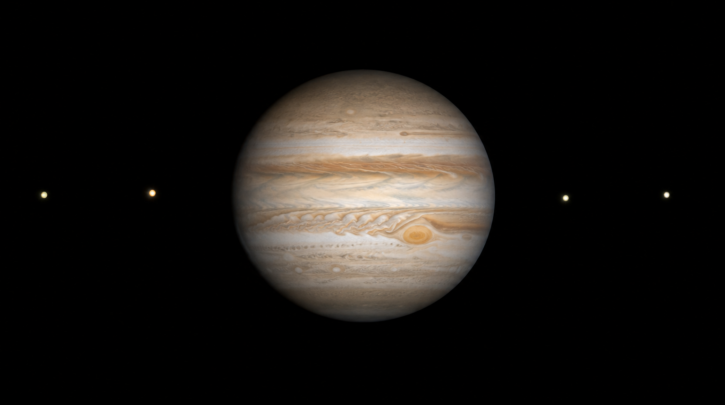

Jupiter’s four largest moons — Io, Europa, Ganymede, and Callisto — are bright enough to see in ordinary binoculars, and watching their positions change from night to night is one of the most accessible, genuinely dynamic sights in amateur astronomy.
The Galilean Moons
Named for Galileo Galilei, who discovered them in 1610, these four moons were one of the first pieces of observational evidence against a strictly Earth-centered model of the universe, since they clearly orbited Jupiter rather than Earth. All four are visible as faint points of light in a small telescope, and all four are visible in steady, braced binoculars as well, typically appearing as a short line of two to four points flanking the planet.
Why Binoculars Are Enough
Unlike Saturn’s rings, which need real telescope magnification, the Galilean moons are bright enough that even 7×50 or 10×50 binoculars reveal them clearly, provided they’re held steady — resting your arms or the binoculars against something solid, like a fence post or car roof, makes a real difference. This makes Jupiter’s moons one of the best “wow” targets for a complete beginner with no telescope at all.
Watch Them Change Position
Because the Galilean moons orbit quickly — Io completes an orbit in under two days — their positions relative to Jupiter and each other visibly shift from one night to the next, and sometimes even within a few hours on the same night. Sketching or photographing their positions on consecutive nights and comparing is a simple, genuinely satisfying way to directly observe orbital motion happening in real time, something few other objects in the sky offer so immediately.
Predicting Moon Positions
Planetarium apps and software can show the predicted position of each Galilean moon for any date and time, which helps confirm which point of light is which moon and lets you plan around specific events like a moon passing in front of or behind Jupiter; see our stargazing apps guide for tools that include this kind of planetary moon prediction.
Transits, Shadows, and Eclipses
With a larger telescope and good steady air, it’s possible to watch a moon transit directly across Jupiter’s face, see the small black dot of that moon’s shadow crossing the cloud tops below it, or watch a moon disappear into Jupiter’s own shadow during an eclipse. These events require more aperture and more precise timing than simply spotting the moons, but they’re genuinely dramatic to witness and worth planning around using a prediction tool once you’re ready to go beyond basic moon-spotting.
Jupiter’s Cloud Bands and Great Red Spot
Beyond the moons, a modest telescope under good conditions reveals Jupiter’s dark equatorial cloud bands directly. The Great Red Spot, a massive, long-lived storm, needs a larger telescope (roughly 6 inches or more) and steady air to see clearly, and it’s only visible when Jupiter’s roughly 10-hour rotation has brought it to face Earth — checking a prediction tool for Great Red Spot transit timing avoids the disappointment of observing at exactly the wrong time.
A Great First Telescope Target
Jupiter and its moons reward even modest equipment with genuinely interesting detail, which makes it one of the best targets to start with once you move beyond naked-eye and binocular observing; see our planetary telescope guide for options that handle Jupiter well without requiring a large investment.
Finding Jupiter in the First Place
Jupiter is bright enough that once you know its rough position for the current season, it’s usually the brightest steady point of light in that part of the sky, outshining all but Venus. A planetarium app removes any guesswork by showing exactly where it sits relative to familiar constellations on a given night; see our stargazing apps guide for options that handle this well.
A Fast-Changing, Rewarding Target
Because Jupiter rotates quickly and its moons orbit visibly fast, a single extended observing session — even just an hour or two — can show real, detectable change: a moon shifting position, a shadow beginning to cross the disk, or cloud bands rotating slightly. Few naked-eye or telescope targets reward patient, extended observation with this much visible motion in such a short window, which is a big part of why Jupiter remains a perennial favorite even among experienced observers.
It’s rare for a target this easy to find to also reward close, repeated attention as much as Jupiter does.