
Nebulae aren’t one thing — the word covers several genuinely different objects, from glowing star-forming clouds to the expanding wreckage of exploded stars, each with a different cause, appearance, and best viewing approach.
Emission Nebulae
Emission nebulae are clouds of gas, mostly hydrogen, that glow because nearby young, hot stars ionize the gas directly — the Orion Nebula (M42) is the classic and most rewarding example, bright enough to see with the naked eye as a fuzzy patch in Orion’s sword and genuinely impressive in any telescope. Photographs show these nebulae in vivid reds and pinks from hydrogen-alpha emission, though visually they typically appear as a pale gray-green glow to the eye.
Reflection Nebulae
Reflection nebulae don’t glow on their own — they’re dust clouds simply reflecting the light of nearby stars, which is why they tend to appear blue in photographs, similar to why Earth’s sky is blue from sunlight scattering. Part of the Pleiades cluster (M45) is wrapped in a faint reflection nebula, though it’s genuinely challenging to see visually and shows up far more clearly in long-exposure photographs than through an eyepiece.
Planetary Nebulae
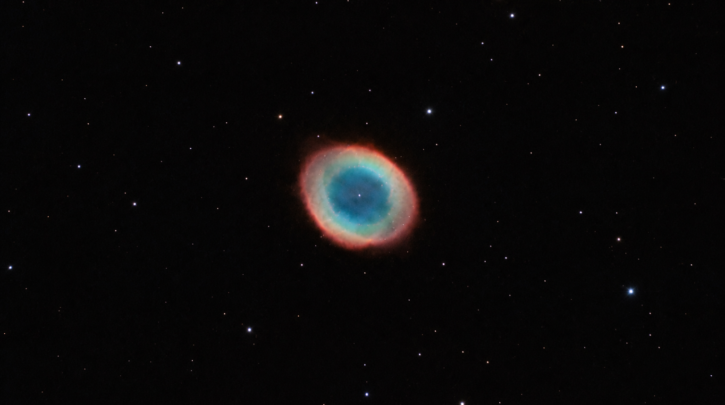
Despite the name, planetary nebulae have nothing to do with planets — they’re the outer layers of a dying, sun-like star, expelled into a small, round or disk-shaped cloud that early observers thought resembled a planet’s disk through the telescopes of the time. The Ring Nebula (M57) and Dumbbell Nebula (M27) are two well-known, telescope-friendly examples, both compact enough to show real shape even in modest apertures.
Supernova Remnants
Supernova remnants are the expanding debris field left behind by a massive star’s explosive death, typically faint, wispy, and irregular in shape. The Crab Nebula (M1), remnant of a supernova recorded by astronomers in 1054 CE, is the best-known example, though it’s considerably fainter and less visually dramatic through an eyepiece than its fame might suggest.
Why Nebulae Look Gray Through an Eyepiece
Human night vision relies on rod cells that are highly sensitive to faint light but essentially color-blind, which is why most nebulae — genuinely, vividly colored in long-exposure photographs — appear as gray or faintly greenish smudges through a traditional eyepiece regardless of aperture. Only the very brightest nebulae, like Orion’s, show even a hint of color to experienced observers under excellent conditions.
Narrowband Filters
UHC and OIII filters, which screw onto an eyepiece, block much of the light pollution spectrum while passing the specific wavelengths emission and planetary nebulae emit, dramatically improving contrast against a light-polluted sky. These filters are one of the best low-cost upgrades for traditional nebula hunting specifically, though they don’t help with reflection nebulae or galaxies, which don’t share that narrow emission spectrum.
Where Smart Telescopes Make the Biggest Visual Difference
Nebulae are arguably the single best demonstration of what live image stacking adds over traditional visual observing — a smart telescope pointed at the Orion or Ring Nebula for a few minutes reveals genuine color and structure approaching what a processed photograph shows, rather than the gray smudge a traditional eyepiece delivers on the same object. For anyone who’s been disappointed by how colorless real nebulae look through a standard telescope, this is the most direct fix available; see our deep-sky observing guide for the stacking process behind it.
See real nebula color and structure through live stacking View Unistellar smart telescopes
A Suggested Nebula Starting List
Begin with the Orion Nebula (M42), bright and rewarding at any equipment level and visible in the Northern Hemisphere winter sky; move to the Ring Nebula (M57) once you’re comfortable finding fainter, smaller targets; then try the Dumbbell Nebula (M27) and, with a narrowband filter and a dark sky, the Veil Nebula supernova remnant. This progression matches the general difficulty curve described in our deep-sky observing guide.
Nebulae and the Broader Star Life Cycle
Each nebula type actually represents a different chapter in a star’s life — emission nebulae mark active star formation, planetary nebulae mark an ordinary star’s gentle end, and supernova remnants mark the violent death of a much more massive star. Understanding that connection turns nebula hunting into something more than collecting faint smudges — each object is a different snapshot of stellar life and death, genuinely happening across the galaxy on timescales far longer than any human observation.
That context is part of why nebulae remain some of the most requested and most rewarding deep-sky targets, whatever equipment you’re using to find them.