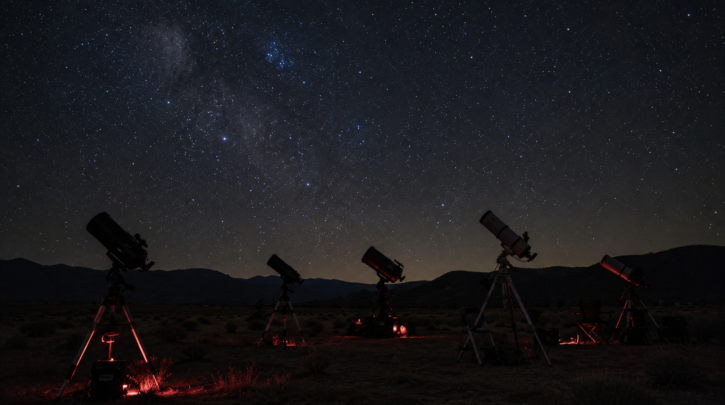

A star party is a gathering of amateur astronomers, ranging from a handful of local club members meeting in a field to multi-day events drawing thousands, all built around one shared idea: bringing telescopes together under a dark sky and sharing views with each other.
What Actually Happens
Attendees set up telescopes across an open, dark field as the sun sets, and through the night people wander between setups, looking through whatever telescope happens to be pointed at something interesting and chatting with its owner. Larger events add vendor areas for astronomy gear, evening talks and lectures from experienced observers or visiting experts, and sometimes astrophotography competitions, but the core activity everywhere is the same: shared telescope time under genuinely dark skies.
Local Club Star Parties
Most astronomy clubs host regular, often monthly, star parties that are free or low-cost and welcoming to complete beginners — a much lower-commitment starting point than a major multi-day event. These local gatherings are usually the best place to look through several different types of telescopes before deciding what to buy yourself; see our beginner telescopes guide for the options you’re likely to see represented.
Larger, Named Events
Beyond local clubs, several long-running, well-known star parties draw attendees from across the country or even internationally, often held annually at a fixed dark-sky location and lasting several days. These larger events typically require advance registration and offer a wider range of vendors, speakers, and specialized equipment on display than a local club gathering would, though checking current dates and registration details directly with each event is essential since specifics change from year to year.
Red Lights Only
The single most important rule at any star party is no white light after dark — flashlights, phone screens, and car headlights all ruin the dark adaptation of everyone else’s eyes across the whole field, not just your own. Every experienced attendee brings a red flashlight or a phone in red night mode, and most events ask attendees to park and set up before sunset specifically to avoid headlights sweeping across the field after dark; see our stargazing basics guide for why dark adaptation matters so much in the first place.
Other Etiquette Worth Knowing
- Ask before touching or adjusting someone else’s telescope
- Keep conversation at a reasonably quiet volume, especially near people actively observing or photographing
- Don’t linger too long at a popular telescope if a line has formed behind you
- Offer a look through your own telescope if you have one set up — it’s how the whole culture works
- Check the specific event’s rules in advance, since some add restrictions around vehicle lights, generators, or pets
What to Bring
Beyond your own telescope or binoculars if you have them, warm layers (deserts and open fields get surprisingly cold overnight even in summer), a chair, and snacks are the practical basics — you don’t need a telescope at all to attend and enjoy a star party, since there’s always someone happy to share a view; see our packing list guide for a fuller rundown.
Why Star Parties Are Worth Attending Early
For a beginner still deciding what equipment to buy, a star party is close to invaluable — an evening spent comparing views through a Dobsonian, a refractor, and a smart telescope side by side teaches more about what actually matters to you personally than any amount of reading gear reviews online.
Finding a Star Party Near You
Local astronomy clubs are usually the easiest to find through a quick search for clubs in your region, and most maintain a regular public schedule posted well in advance. For larger named events, astronomy magazines and dedicated astronomy event calendars are the more reliable sources for current dates, since these events sometimes shift locations or timing from year to year.
What Makes a Star Party Different From Solo Observing
Beyond simply seeing more through more telescopes, the social element is a genuine draw in its own right — trading tips with experienced observers, hearing the story behind someone’s custom-built telescope, or just sharing the excitement of a particularly good view of Saturn with a stranger who’s equally thrilled. Astronomy is often a solitary hobby by necessity, since a session usually means one person and one telescope, so a star party’s shared atmosphere is a welcome change of pace many observers come back for year after year.
If you’ve never been to one, it’s worth treating the first visit as low-stakes reconnaissance — go, watch, ask questions, and let the experience itself tell you how central star parties might become to your own routine.