
The aurora borealis is one of the few astronomical sights that’s genuinely unpredictable on any given night, driven by activity happening on the Sun days earlier rather than a fixed, calculable schedule like an eclipse or planetary opposition. Understanding what actually causes it, and how to read the forecasting tools available, turns aurora chasing from pure luck into something you can meaningfully improve your odds at.
What Causes the Aurora
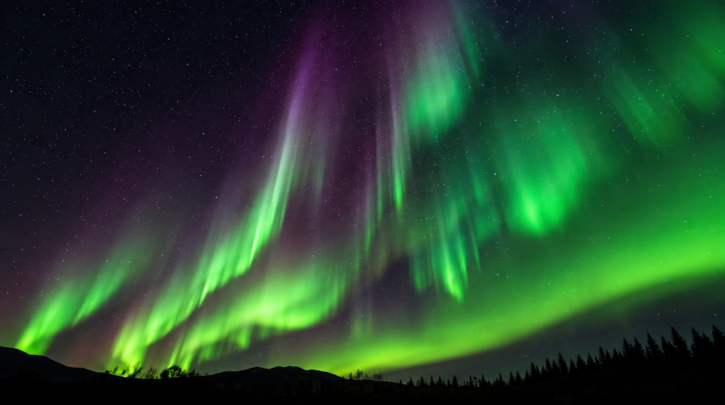
The aurora happens when charged particles from the solar wind interact with Earth’s magnetic field, which funnels them toward the polar regions where they collide with gases in the upper atmosphere. Those collisions excite oxygen and nitrogen atoms, which release light as they settle back down — oxygen typically produces green and red light depending on altitude, while nitrogen contributes blue and purple tones, which is why a strong display can show a genuine range of color rather than just the green most people picture.
The Solar Cycle and Space Weather
The Sun runs on a roughly 11-year cycle of rising and falling activity, and aurora frequency and intensity track closely with it — more sunspots and more coronal mass ejections (CMEs, large eruptions of solar material) during solar maximum mean more frequent and more intense aurora displays reaching farther from the poles than usual. A strong CME aimed roughly at Earth is what produces the most dramatic, lower-latitude aurora events, including rare occasions where the aurora becomes visible across much of the continental US.
The Kp Index
Geomagnetic activity is measured on the Kp index, a scale from 0 to 9 that quantifies how disturbed Earth’s magnetic field is at a given time. Higher Kp values correspond to the aurora oval — the ring-shaped region around the magnetic pole where the aurora is most active — expanding toward lower latitudes, which is why a Kp 3 night might only show aurora in Alaska while a Kp 7 or 8 night can bring it into the northern continental US or even farther south; see our aurora forecast guide for how to check current and predicted Kp values.
Best Viewing Conditions
Beyond a strong enough geomagnetic storm, the aurora needs the same basic conditions as any other faint sky phenomenon: genuine darkness away from light pollution, a moon that’s dim or below the horizon, and clear skies with no cloud cover; see our light pollution guide for why dark skies matter so much here too. Late night and the hours around local magnetic midnight often see the most activity, though displays can occur at almost any time after dark during a strong storm.
Why the Aurora Often Looks Different to the Eye
Cameras, especially with a longer exposure, gather more light than the human eye can process in real time, which means photos frequently show more vivid color and structure than what an observer actually perceives standing under a moderate display. A pale, grayish-green glow to the naked eye can turn into a vivid green-and-purple curtain in a several-second exposure — this doesn’t mean the display wasn’t real, just that the camera is doing some of the same signal-gathering work a telescope’s stacking process does for faint deep-sky objects; see our aurora photography guide for the settings that capture this well.
Facing the Right Direction
For most of the continental US, the aurora appears low on the northern horizon rather than overhead, since the auroral oval sits north of these latitudes even during a moderate storm — only a genuinely strong event brings the display high overhead this far south. Finding a viewing spot with a clear, unobstructed view toward the north, ideally with no hills, trees, or buildings blocking that horizon, matters more for aurora chasing than for almost any other kind of skywatching.
Patience and Persistence
Aurora displays can be highly variable within a single night — quiet for an hour, then suddenly active, then fading again — which rewards patience and repeated checks rather than giving up after one quick look outside. Combining a real-time Kp nowcast with your own eyes, checking every 30 minutes or so during a promising night, catches far more activity than a single glance; see our US viewing guide for where those odds are naturally better to begin with.
Aurora Australis: The Southern Counterpart
Everything about the physics applies equally to the Southern Hemisphere’s aurora australis, driven by the same solar activity funneling toward the south magnetic pole. It’s seen far less often simply because there’s much less inhabited land at the relevant southern latitudes — mainly southern New Zealand, Tasmania, and Antarctic research stations — compared to the populated northern regions where aurora borealis tourism has grown around Alaska, Scandinavia, and Canada.
A Realistic First Attempt
For a first aurora-chasing attempt, checking a Kp forecast for a night with at least moderate predicted activity, picking a genuinely dark spot with a clear northern horizon, and giving yourself a couple of hours rather than a single quick look sets reasonable expectations. Even a modest display, once you know what to actually look for, is a memorable enough experience to make the planning worthwhile.