
Aurora forecasting is genuinely less precise than ordinary weather forecasting, with reliable lead times often measured in hours rather than days. Knowing which tools to check, and being honest about their real limitations, saves a lot of wasted trips chasing a forecast that was never very certain to begin with.
NOAA’s Space Weather Prediction Center
The US government’s Space Weather Prediction Center is the authoritative source for Kp index forecasts, aurora oval maps, and solar wind data, and most aurora apps ultimately draw from this same underlying data. Its 3-day Kp forecast gives a general sense of upcoming geomagnetic activity, though the shorter-term “nowcast” — based on real-time solar wind measurements — is considerably more reliable than the multi-day outlook.
Why Lead Time Is So Short
A coronal mass ejection typically takes one to three days to travel from the Sun to Earth, which sets the outer bound on useful forecast lead time — astronomers can often see a CME erupt and estimate roughly when it might arrive, but the exact timing, strength, and whether it will produce a strong aurora display all carry real uncertainty until it actually arrives. The most precise warning comes from spacecraft positioned between the Sun and Earth that measure the solar wind directly as it passes, typically giving only about 30 to 60 minutes of advance notice before conditions actually reach Earth.
Apps and Notification Services
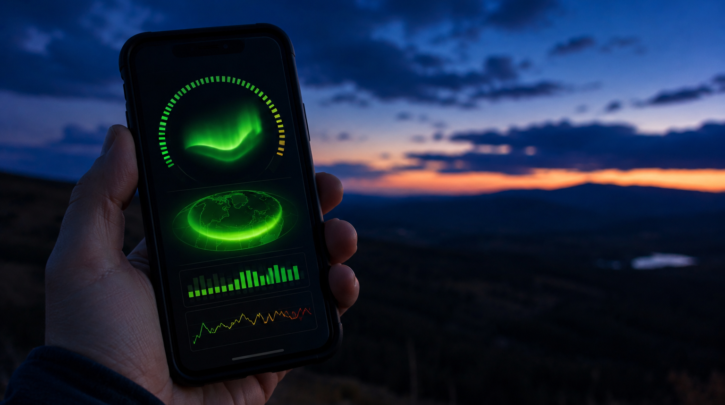
Aurora-specific apps aggregate this same NOAA data into more accessible formats, often adding push notifications when Kp values cross a threshold relevant to your saved location. These are convenient for casual monitoring without checking a website manually, but they’re only as good as the underlying forecast data, so understanding the real uncertainty behind the numbers matters more than which specific app you use.
Reading a Kp Forecast Realistically
A forecast Kp of 5 or 6 a few days out is worth watching but shouldn’t be treated as a certainty — solar storms frequently under- or over-perform their initial predictions once they actually arrive. Treating a promising multi-day forecast as a reason to plan a flexible trip, then relying on the much more reliable short-term nowcast on the actual night, is a more realistic approach than booking hard travel plans around a forecast made several days in advance.
Combining Aurora and Weather Forecasts
A strong geomagnetic storm is useless if it’s cloudy, so checking a conventional cloud-cover forecast alongside the aurora-specific data is just as important as the Kp number itself. Some dedicated aurora apps combine both into a single view, while others require checking a separate weather app directly; either way, both pieces of the picture matter equally.
Moon Phase Still Applies
A bright moon washes out fainter aurora displays the same way it washes out the Milky Way or faint deep-sky objects, so checking moon phase alongside both the aurora and weather forecasts completes the full picture; see our Milky Way guide for how much moon phase matters for faint sky phenomena generally.
Setting Realistic Expectations
Given the genuinely short reliable lead time, the most successful aurora chasers treat forecasting as a rough guide for when to pay closer attention and stay flexible, rather than a guarantee that justifies rigid travel plans made far in advance. Checking conditions the same evening, and being ready to head to a dark viewing spot on short notice, matters more than any forecast made days ahead.
Signing Up for Alerts
Many aurora apps and some regional astronomy clubs offer text or push alerts tied to a specific Kp threshold, which is a genuinely useful way to get notified of a promising night without manually checking a forecast every day. Setting the alert threshold to match your own realistic viewing location — lower for northern areas, higher for anywhere farther south — avoids being notified constantly for activity that wouldn’t actually be visible from where you live.
Learning From Past Displays
Keeping a simple log of which Kp values actually produced a visible display from your own specific viewing location, over time, builds a much more personally useful sense of your realistic threshold than any general rule of thumb — local horizon obstructions, typical cloud patterns, and even your own eyes’ sensitivity all factor into what Kp value reliably produces a result for you specifically.
Over a season or two of casual monitoring, most aurora chasers develop a genuinely accurate personal sense of when it’s actually worth heading outside, which is ultimately more useful than any single forecasting tool on its own.