
Solar eclipse safety isn’t an overstated precaution — looking directly at the Sun during any partial phase, even when most of it is covered by the Moon, can cause genuine, permanent eye damage, since the exposed sliver remains bright enough to harm the retina. Understanding exactly what’s safe and what isn’t removes any ambiguity before you head outside.
The Core Rule
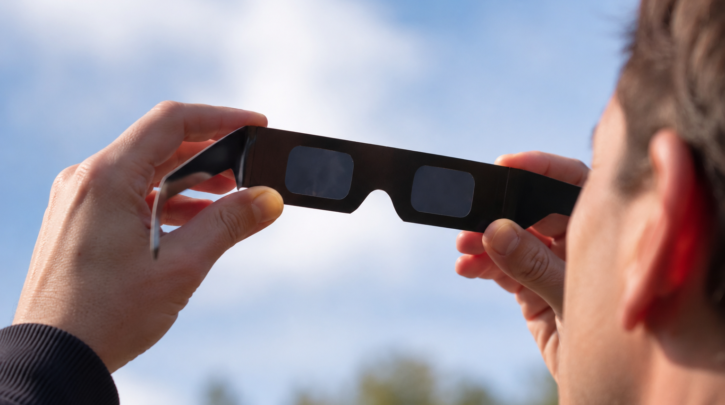
Never look directly at the Sun without certified eclipse glasses or a proper solar filter, except during the brief total phase of a total solar eclipse when the Moon has fully covered the Sun’s disk. This applies to every partial phase, annular eclipses in their entirety (since the Sun is never fully covered), and ordinary sunlight on any non-eclipse day.
Certified Eclipse Glasses
Safe eclipse glasses meet the ISO 12312-2 international safety standard, which blocks the intense visible, ultraviolet, and infrared solar radiation that damages the eye. Ordinary sunglasses, no matter how dark, do not provide this protection and should never be used to look at the Sun. The American Astronomical Society maintains a list of reputable, verified eclipse-glasses vendors, which is worth checking against before buying, since counterfeit glasses claiming false certification have circulated during past major eclipses.
Inspecting Glasses Before Use
Before each use, check eclipse glasses for scratches, punctures, or delamination of the filter material, and never use a pair that shows any damage, however minor it looks. Properly certified glasses should make even the brightest household lights essentially invisible or barely a dim glow — if ordinary bright light comes through clearly, the glasses aren’t safe to use.
The One Safe Exception: Totality Itself
During the actual total phase of a total solar eclipse — when the Moon has fully covered the Sun’s bright disk — it’s genuinely safe to remove eclipse glasses and view the corona directly with the naked eye, and doing so is part of the experience. The instant any sliver of the Sun’s bright surface reappears, marking the end of totality, glasses must go back on immediately. This exception applies only within the path of totality during a total eclipse; it never applies to a partial or annular eclipse, where the Sun’s bright disk is never fully covered.
Solar Filters for Telescopes, Binoculars, and Cameras
Any optical instrument — telescope, binoculars, camera with a telephoto lens — concentrates sunlight and must never be pointed at the Sun without a proper solar filter covering the front of the instrument, the end facing the Sun, not the eyepiece end. A filter placed at the eyepiece end can crack or fail from concentrated heat and light passing through the full optical system first, which is a genuinely dangerous, outdated design that reputable manufacturers no longer produce.
Pinhole Projection: A Completely Safe Alternative
Projecting the Sun’s image through a small pinhole onto a card or the ground, rather than looking at the Sun directly at all, is a completely safe way to view the progress of a partial eclipse. A simple pinhole in a piece of cardboard, held to cast a small image of the crescent Sun onto another surface, works well and involves zero risk to your eyes, making it a good option for young children or anyone without eclipse glasses on hand.
Photographing an Eclipse Safely
A phone or camera pointed at the Sun needs the same protection your eyes do — an unfiltered zoomed camera view can also risk eye damage if you’re looking through an optical viewfinder, and unfiltered direct sun exposure can damage a camera sensor as well; see our eclipse photography guide for how to set up a camera safely for every phase of the event.
Special Considerations for Children
Children need supervision and clear, repeated instruction during an eclipse event, since the temptation to peek without glasses is real and the consequences of eye damage are serious and can be permanent. Pinhole projection is often the safer, lower-supervision option for young children who may not reliably keep glasses on throughout a multi-hour partial eclipse.
Homemade Filters Are Not Safe
Improvised filters — exposed film negatives, compact discs, smoked glass, multiple layers of ordinary sunglasses, or a floppy disk’s magnetic layer — have all circulated as folk remedies for eclipse viewing over the years, and none of them provide reliable, adequate protection. Only glasses and filters specifically manufactured and certified for solar viewing, meeting the ISO 12312-2 standard, should ever be trusted for direct viewing.
Symptoms of Eye Damage
Solar retinopathy — eye damage from unfiltered sun viewing — often causes no immediate pain, which is part of why it’s so dangerous, since a person can damage their retina without feeling anything wrong in the moment. Symptoms like blurred vision, a blind spot, or distorted vision typically appear hours later and warrant prompt medical attention, though the safest approach is entirely avoiding the exposure in the first place rather than relying on any warning sign during the viewing itself.