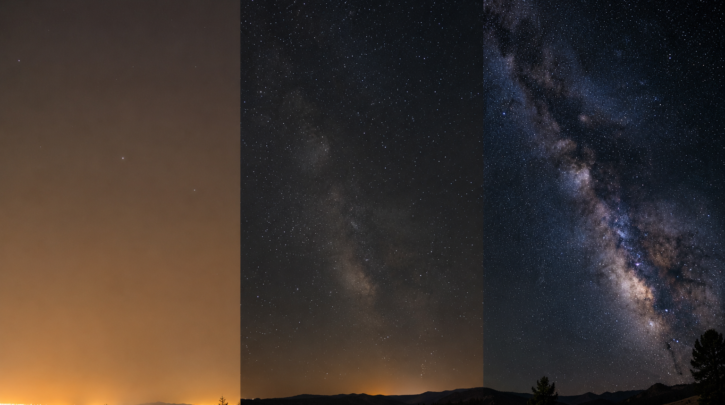

The Bortle scale rates night sky darkness on a 9-point scale, from Class 1 (the darkest skies on Earth) to Class 9 (bright inner-city skies). Understanding it turns a vague sense of “my sky isn’t very dark” into a specific, comparable rating that predicts what’s actually visible.
Where the Scale Comes From
Amateur astronomer John Bortle created the scale in 2001 and published it in Sky & Telescope magazine, intending to give observers a consistent way to describe and compare sky darkness beyond vague terms like “pretty dark” or “not bad.” It quickly became the standard reference across amateur astronomy for describing a site’s sky quality.
The Nine Classes
| Class | Description | What’s Typically Visible |
|---|---|---|
| 1 | Excellent dark-sky site | Milky Way casts visible shadows; zodiacal light easily seen |
| 2 | Typical truly dark site | Milky Way shows rich structure; airglow may be noticeable |
| 3 | Rural sky | Milky Way still impressive; some light pollution near horizon |
| 4 | Rural/suburban transition | Milky Way visible but loses some structure |
| 5 | Suburban sky | Milky Way washed out overhead; only brighter portions visible |
| 6 | Bright suburban sky | Milky Way barely visible if at all |
| 7 | Suburban/urban transition | Sky glows grayish-white; only brighter deep-sky objects visible |
| 8 | City sky | Sky glows orange-gray; only Moon, planets, brightest stars visible |
| 9 | Inner-city sky | Only Moon, planets, and a handful of brightest stars visible |
Estimating Your Own Sky
A simple naked-eye test is comparing how many stars you can see within a familiar constellation against a reference chart showing that constellation at each Bortle level — fewer visible faint stars means a brighter, higher-numbered class. Online light pollution maps, built from satellite brightness data, offer a faster if slightly less personal estimate for any specific location, useful for comparing your home sky against a potential trip destination before you travel.
What Changes at Each Level for Different Targets
The scale affects different objects very differently. Planets and the Moon remain excellent targets even at Class 8 or 9, since they’re bright enough to shine through significant sky glow; see our planet watching guide for how little light pollution actually limits planetary observing. Deep-sky objects — galaxies and faint nebulae — are far more sensitive, typically needing Class 4 or darker to show real detail; see our deep-sky observing guide for how steeply that dropoff affects faint targets specifically.
Limitations of the Scale
The Bortle scale is inherently somewhat subjective and was originally designed around visual naked-eye impressions rather than a precise instrument-measured standard, and a single site can vary by direction — a location might show a Class 3 sky overhead but a visible light dome toward a nearby town on one horizon. More recent tools supplement the traditional scale with actual measured sky brightness data, which gives a more precise, if less intuitively described, picture than the original 9-class system alone.
Using the Scale to Plan a Trip
Knowing your home sky’s approximate Bortle class, and checking the class of a potential destination before traveling, sets realistic expectations for how much of an upgrade a trip will actually deliver — moving from Class 6 to Class 4 is a real improvement, but moving from Class 6 all the way to Class 2 or 1 is a genuinely transformative difference worth planning a dedicated trip around; see our dark-sky destinations guide for where those darkest skies are actually found.
The Scale as a Shared Language
One of the Bortle scale’s most practical benefits is simply giving observers a shared vocabulary — describing a site as “Class 3” communicates far more precisely than “pretty dark” when comparing notes with other astronomers, planning a group trip, or reading a gear review that mentions what sky conditions a test was performed under. This shared reference is part of why the scale caught on so widely despite its acknowledged imprecision.
Tracking Changes Over Time
Because light pollution tends to increase as nearby areas develop, a location’s Bortle class isn’t necessarily permanent — a backyard that measured Class 4 a decade ago might now sit closer to Class 5 or 6 after nearby development, while a community that has adopted dark-sky-friendly lighting ordinances might see a class improve over time. Rechecking your own sky’s rating periodically, especially after neighborhood development or new streetlight installations, keeps expectations accurate.
A rating that was accurate five years ago isn’t guaranteed to still hold today, so treating it as a living estimate rather than a permanent fact serves observers better in the long run.